01Wuxi City lies in the …
Wuxi City lies in the southeast of Jiangsu Province, on Taihu Lake to the south and the Yangtze River to the north, 128 kilometers east of Shanghai and 183 kilometers west of Nanjing, covering a total of 4,627.46 square kilometers — an important central city of the Yangtze River Delta and a National Historical and Cultural City. It has more than 3,100 years of recorded history and more than 2,200 years of urban history; Wuxi County was first established in 202 BC and elevated to a prefecture in 1295, and the water-bred pattern of its streets endures to this day. In modern times Wuxi was famed as a major birthplace of China's national industry and commerce, celebrated as "the finest spot on Taihu, the water lanes of Jiangnan, the unrepeatable stretch of the Grand Canal, a century-old city of industry and commerce." The city now administers two county-level cities, Jiangyin and Yixing, and five urban districts — Liangxi, Xishan, Huishan, Binhu and Xinwu — with 7.5374 million permanent residents; fertile plains interleave with lakes and crisscrossing waterways, a quintessential water country of Jiangnan, with 4 national 5A-level scenic areas and 26 national 4A-level scenic areas, where the lake-and-hill cherry blossoms of Yuantouzhu, the ancestral halls and old springs of Huishan Ancient Town, the water lanes beneath Qingming Bridge, and the bamboo sea and zisha of Yixing set one another off, each season with its own sights. In Wuxi the days are slow: cherry blossoms by the lake in spring, oar-sounds on the canal in summer, spring water for tea in autumn, a steaming table of lake delicacies in winter — and once you have tasted the sweet-and-savory xiaolong mantou and pork ribs braised in soy sauce, you understand why this city, praised as the "Pearl of Taihu Lake" and the "flourishing land of Jiangnan," makes people linger.
Most visitors arriving in Wuxi for the first time are won over by its unhurried rhythm. The Yangtze River bars out a stretch of open vastness to the north, Taihu Lake (Lake Tai) unrolls its misty vastness to the south, and the Beijing–Hangzhou Grand Canal threads through the city without hurry, stitching lake light, water color and everyday street life into one cloth. "The finest spot on Taihu, the water lanes of Jiangnan" — old Wuxi folk speak of their hometown with quiet certainty: the lake has its immensity, the river its grace, and the city lies calmly at the heart of this water network, long used to composure. For travelers, Wuxi's charms are concrete and tangible — a tree of cherry blossom by the lake in spring, a ladle of spring water at the foot of the hills at dawn, a distant view from a stone bridge at dusk — all worth a journey in themselves.
Wuxi is no newcomer. It has more than 3,100 years of recorded history and more than 2,200 years as a city, and is one of the main cradles of Wu culture, Jiangnan culture and canal culture; Wuxi County was first established in 202 BC and elevated to a prefecture in 1295, and the city's name has stayed in use ever since. In modern times, industry and commerce grew quickly in this small lakeside city: Wuxi became one of the birthplaces of China's national industry and commerce and of its township enterprises, with textiles, flour milling and other industries once on a considerable scale, and the city still keeps the old silhouettes of factories, warehouses and historic residences. The north–south traffic the canal brought also kneaded the refinement and openness of neighboring cities into the city's character.
Today Wuxi administers two county-level cities, Jiangyin and Yixing, and five urban districts — Liangxi, Xishan, Huishan, Binhu and Xinwu — covering a total of 4,627.46 square kilometers, with 7.5374 million permanent residents. The city now has 4 national 5A-level scenic areas and 26 national 4A-level scenic areas; lakes and hills, ancient towns, the canal and the bamboo sea each have their own character — a day or two will not be enough, while three or four days let you explore at ease. Drives between sights are mostly short, suited to slowing down and savoring one area at a time without rushing; if you can stay longer, the small Jiangnan cities nearby are all within a high-speed rail ride.
02Speaking of Wuxi
Speaking of Wuxi, Taihu Lake is the first word that cannot be avoided, and the essence of the lake falls mostly on Yuantouzhu (Turtle Head Isle). This peninsula reaching into the lake is now a national 5A-level tourist attraction, surrounded by water on three sides and backed by hills on one; from a high vantage point the water fades from nearby emerald green into the gray-blue of the distance, sails dot the surface, and water meets sky. Locals prize cherry blossoms in spring, cool air in summer, lake views in autumn and gulls in winter — every season has its own attraction. Each spring the cherry blossoms in the park gather like clouds and snow; when the wind passes, petals fall onto the water, and even the waves carry a blush of pink — a scene rarely seen elsewhere in Jiangnan.
At Yuantouzhu, don't miss a boat loop to the islet at the lake's heart. Looking back from the ferry as it leaves shore, the peninsula's outline looms in and out of the mist like an ink painting not yet dry; the islet is small — an hour's circuit — with hill paths, old trees and stone bridges all in place, and from the heights Taihu Lake opens out again with another breadth. Evening light is best: the sunset dyes the water gold-red, returning boats moor slowly, and the lapping of waves against the stone shore helps you understand why men of letters through the ages loved to leave their verses by Taihu Lake. Don't fret if mist and rain set in — Taihu in the rain has its own veiled charm, another face the sunny sky never shows.
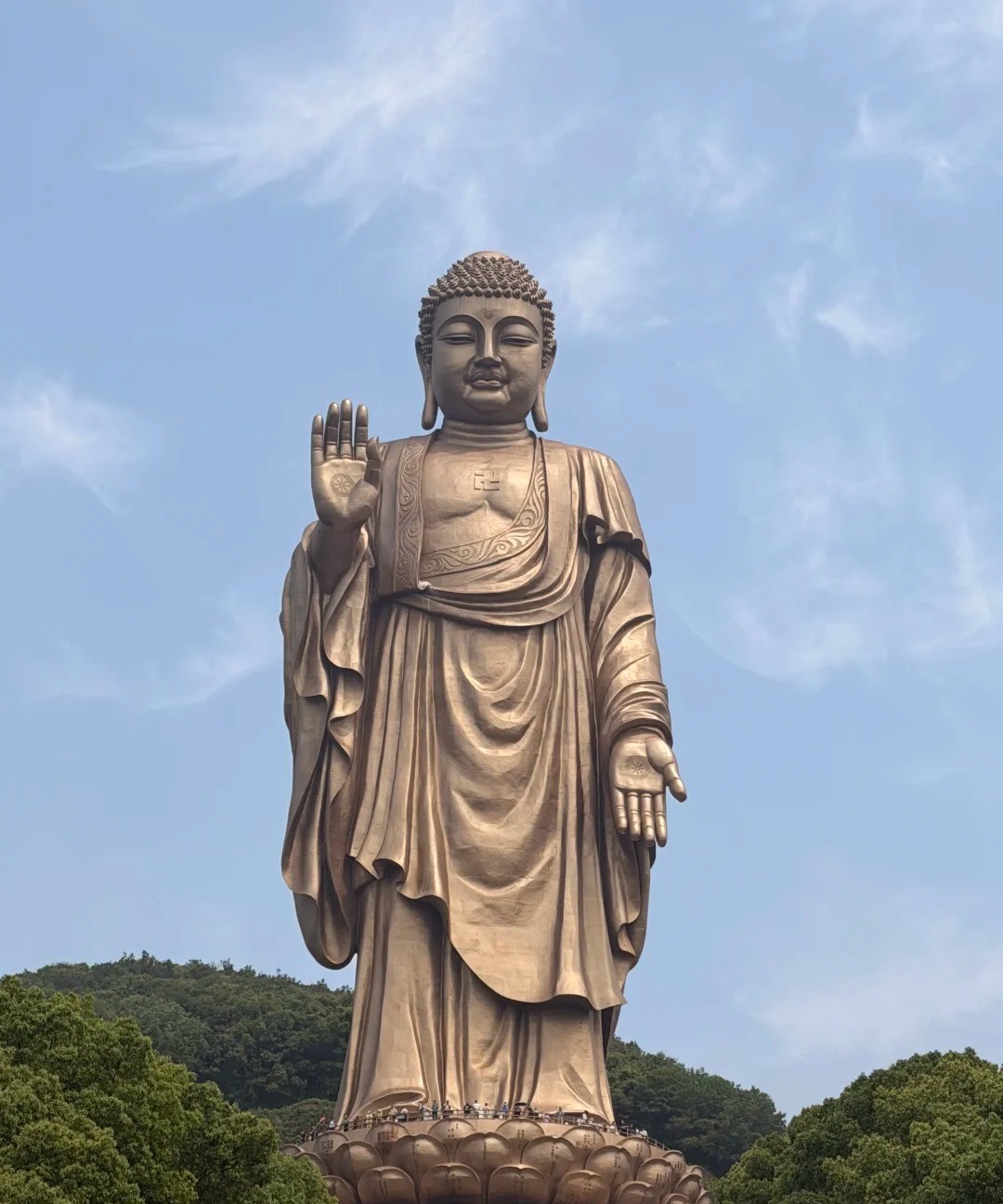
Southwest from Yuantouzhu lies the Mashan Peninsula. Here stands a large Buddhist cultural scenic area, a national 5A-level tourist attraction, backed by hills and facing the lake, grand and open. Its most striking sight is a standing bronze statue of the Buddha, benign in expression with flowing robes, all the more solemn against the backdrop of lake and sky; halls and pavilions climb the hillside, and the dome murals and wood carvings gather much craftsmanship, worth slowing down to study. A water show is staged at fixed times daily — a lotus slowly unfurling, mist breaking into rainbows in the sun — and it draws a crowd. For travelers interested in Buddhist culture, even half a day is not enough here.
Next to the Buddhist cultural area, a Zen-themed town sits by the lakeshore, its white walls and wooden houses, stone bridges and water features arranged with warmth and quiet. This is a place to stay over: sip tea by day, browse the craft shops, sit in on a quiet sutra-copying class; after nightfall the lights come on one by one, lamps shimmer with the ripples, and the whole town holds only wind and insect song. The town's nightscape is the very reason many travelers stay — lodge a slow evening, walk the lakeshore in the thin morning mist, and body and mind both loosen. If time is short, come at dusk for a round of the lanes and a look at the night, and the trip will not have been in vain.
03Back from the lake to …
Back from the lake to the west of the city, Huishan Ancient Town is another world. The town lies on the northeastern slopes of Mount Hui, a branch of the Grand Canal running through it, with ancestral halls densely lining both banks — no fewer than 150 halls arose here over the centuries, bearing many surnames, and their completeness and state of preservation are rare nationwide. In 2012 the Huishan ancestral-hall group was inscribed on China's Tentative List of UNESCO World Cultural Heritage sites, and it remains the city's flagship heritage application. Walking the old street, hall gatehouses stand one after another, their brick carvings, timber frames and plaques each with their own story; calling it an open-air museum of history is no exaggeration. The old street is free to wander — walk slowly and the details never run out.
The spring at the foot of Mount Hui is the source of Wuxi's proudest title, the "Second Spring Under Heaven." Tradition holds the spring was dug in AD 766, and when Lu Yu, the sage of tea of the Tang dynasty, ranked the waters of the realm for brewing tea, he placed the Huishan spring second, and its name spread across the land. The spring has three pools — upper, middle and lower; the upper pool's water is the clearest, and the stone railing still bears the marks of centuries of drawing. From the Song onward, literati vied to write of it; Su Dongpo left the famous line "Alone I carry the small crescent moon of heaven to try the world's second spring," and the erhu piece "The Moon Reflected on the Second Spring" carried this spring across the world on its strings. Standing by the spring pavilion, listening to the water and recalling those verses, is the most fitting close to a visit to Mount Hui.
Two more things in the town must not be missed. One is Jichang Garden, counted among the four great gardens of Jiangnan: small but endlessly winding, it borrows the hill light and pagoda silhouettes beyond its walls, drawing the outside scenery into its ponds — a view with every step, craftsmanship everywhere; the imperial gardens of Beijing once imitated its charm. The other is the Huishan clay figurines: shaped and painted from the black clay at the mountain's foot, with more than 400 years of history, inscribed in 2006 on the first batch of the national intangible cultural heritage list. The figurines fall into rough and fine categories; the painting follows the saying "three parts shaping, seven parts painting," and the classic Da Afu and Axi figures, roly-poly and endearing, are a calling card of Jiangnan folk art — in the town you can still watch artisans molding them by hand.
By the ancient canal in the city's southeast hides one of Wuxi's most atmospheric stretches of water. In 2014 the Grand Canal of China was inscribed on the World Heritage List, and the Qingming Bridge Historic and Cultural Block is one of the heritage points; Bodu Port, with more than 3,000 years of history, meets the Beijing–Hangzhou Grand Canal here, white walls and black tiles, wharves and old kilns lining the banks — the "water lanes of Jiangnan, the unrepeatable stretch of the Grand Canal" refers to exactly this. Qingming Bridge is an old stone arch bridge on the ancient canal; its reflection falls into the water, pleasure boats glide past, and the old street of oar-sounds and lamplight holds both residents and teahouses and small shops. In modern times this was one of the birthplaces of national industry and commerce; the past of the silk mills and kilns now sits in the street-side museums, worth a visit.
04On the shore of Lihu L…
On the shore of Lihu Lake in the city's southwest stands Liyuan Garden. Legend tells that Fan Li of the Spring and Autumn period, having helped Yue destroy Wu, sailed the five lakes with Xishi and retired here — both the lake and the garden bear his name. This national 4A-level tourist attraction excels in water scenery: lakeside corridors and pavilions wind along, rockeries of Taihu stones spiral in layers, and threading through them is delightful; from the heights, Lihu Lake spreads wide and gentle, the skyline of the new town and the near pavilions framed together, ancient and modern oddly overlapping. Come in spring when peach blossoms line the banks and willow strands brush the water — one of the liveliest pictures among the gardens of Jiangnan.
On the shores of Taihu Lake there is also a period-style film park famous as a location for costume dramas, likewise a national 5A-level tourist attraction. The city gates and gate towers, the horse-riding grounds and the water-town streets are all built to ancient form; visitors often walk straight into a live mounted-battle show — armored actors with halberds, war horses raising dust, drums and narration — a lively, stirring spectacle. Children can dress in period costume for photos, ride an antique carriage, and feel beneath the city wall what the stories from their textbooks look like; for film fans, walking through familiar scenes is a pleasure in itself, and looking back at the walls and towers from a boat on the lake gives a lingering sense of standing between drama and reality. Families with children will likely spend the better part of a day here.
Yixing, on the southwest shore of Taihu Lake, is the county-level city under Wuxi's administration, a land of many hills and much bamboo with a wilder charm of its own. The bamboo-sea scenic area here is a national 4A-level tourist attraction: green bamboo rolls with the contours of the hills, and when the wind passes the bamboo surges like waves — step into the groves in high summer and the heat falls away at once. The hills also hide many caves: Shanjuan Cave, Zhanggong Cave and the others are 4A-level attractions too, their stalactites and stalagmites of every shape, warm in winter and cool in summer, pairing with the green bamboo above as two ways to visit, one cool, one green. Having seen the softness of the water towns, come to Yixing for the blue of the hills and the wonder of the caves — one city offering two utterly different landscapes; this is Wuxi's variety.
Yixing's louder calling card is zisha. The craft of zisha pottery takes shape by patting slabs of clay, the only such traditional pottery craft surviving in China; mature since the Ming dynasty, it has more than 600 years of history, was inscribed in 2006 on the first batch of the national intangible cultural heritage list, and is concentrated around Dingshu Town. Zisha clay is fine-textured; teapots made from it breathe well and keep tea's true flavor, long prized by tea people; decorative crafts such as carved inscriptions and clay painting fold poetry, calligraphy and painting into the vessels — one pot is an object to savor at the desk. On Dingshu's old street and in the ceramics museum, from crude everyday jars to exquisite masters' pots, you can take in the whole past and present of this craft.
05Jiangyin lies north of…
Jiangyin lies north of Wuxi, where the Yangtze River narrows; the river is mighty here, a fine place to watch the great stream. This riverfront city was also a heavyweight of modern industry and commerce, and the banks keep the old traces of a fortress and a riverside promenade; Xu Xiake, the great traveler of the Ming dynasty, was a Jiangyin man, and his former residence, now a 2A-level attraction, draws most who love geography and far journeys. The drive between Jiangyin and Wuxi's urban districts is short; with room in the itinerary, pairing the Yangtze's grandeur with Taihu Lake's gentleness in one trip — one firm, one soft — sets each off against the other. A gust of river wind on the embankment, watching the barge trains pass slowly, has its own kind of openness.
Half of Wuxi cuisine's fame rests on one word: sweet. Outsiders are often caught off guard by it, while locals feel the sweetness has its own measure — sweet but never cloying, and that is the skill. Wuxi's xiaolong mantou (soup dumplings) is the lead on this sweet calling card: thin skin, plentiful soup, fresh and sweet; bite one open, sip the soup first, then eat the filling, the savory juice sweetly present, perfect with a dish of shredded ginger in vinegar. The craft of making xiaolongbao is inscribed on the fourth batch of Jiangsu Province's intangible cultural heritage list; snack shops on nearly every street sell them, and a bowl of wonton alongside makes the comforting local breakfast.
The other signature dish is pork ribs braised in soy sauce. The craft of Wuxi's pork ribs braised in soy sauce is inscribed on the first batch of Jiangsu Province's intangible cultural heritage list; the finished dish is soy-red in color, the bone tender and the meat soft, sweet and salty in balance — sweet at first bite, a savory echo as you swallow, fragrance soaked into every crevice of the bone. Lines form year-round at the time-honored shops, and vacuum-packed pork ribs braised in soy sauce are a favorite souvenir. There is also qingshui youmianjin (fried gluten balls), likewise on the provincial intangible heritage list and a common home-kitchen ingredient; behind this interweaving of sweet and salty lies the composed palate nurtured in the prosperous years of this city of industry and commerce.
Beside Taihu Lake, lake delicacies naturally take the stage. Both the Taihu boat banquet and Taihu boat dim sum are on the provincial intangible cultural heritage list: the boat banquet sets a feast amid the lake light, the dishes traveling with the boat; the boat dim sum shapes snacks small and pretty — both carry the spirit of the water towns. Lakeside households cook the lake's catch for its true flavor; steaming or boiling, freshness comes first and seasoning stops at the right point — what you taste is that first tender mouthful straight from the water. In early spring, lakeside families bring seasonal vegetables to the table, a fresh match for the fish. To eat a boat banquet you need not chase famous restaurants: sit with a lakeside family by the water, a few small dishes and a pot of tea, the lake wind through the room — and the taste of Taihu Lake is all there.
06Wuxi lies in the north…
Wuxi lies in the north subtropical humid monsoon zone, with four distinct seasons, ample heat and abundant rain, rain and heat in the same season. The annual mean temperature is 15.6 degrees Celsius and annual precipitation 1,095.1 millimeters; summers are hot and humid, winters damp and cold, and summer brings much rain — carry rain gear. For travelers, spring and autumn are the most comfortable: the cherry blossoms of Yuantouzhu in March and April are the year's most popular sight, and after September the sky is high and the clouds thin, the lake and hills clear — fine for climbing and for spring bathing. Sanmaofeng, the main peak of Mount Hui, stands 329 meters above sea level — no hard climb; go up at dawn or dusk in autumn and you often catch light that gathers the whole city below.
Wuxi sits in the heart of the Yangtze River Delta, 128 kilometers east of Shanghai and 183 kilometers west of Nanjing — a little over half an hour by high-speed rail from Shanghai, quick from Nanjing too; civil flights link the main domestic cities, and road, rail, water and air are all at hand. In the city, the metro threads together the railway stations, the old town and a number of scenic areas; buses take QR-code payment, and short taxi rides are easy. Sights spread across the urban districts and the two cities of Jiangyin and Yixing; within the urban districts, most scenic areas are one metro ride or a short drive apart, while Yixing's bamboo sea deserves a full day so the round trip is unhurried.
If you have three or four days, try this: give day one to Taihu Lake — a morning boat to the isle at Yuantouzhu, an afternoon stroll along the shore, and a lake sunset at dusk; day two to Mashan — the great Buddha in the morning, then tea and a night's stay in the Zen town, watching the night fall; day three back in the city, stringing together the ancestral halls of Huishan Ancient Town, the Second Spring, Jichang Garden and the clay-figurine shops at an easy pace, then an evening ride on the night cruise at Qingming Bridge; day four to Yixing, choosing between the bamboo sea and the caves, and bringing a zisha pot home. Wuxi is not a place that asks you to hurry; its goodness hides in a gust of wind on the lake, a cup of tea by the spring, the first breath of steam as the steamer lid lifts. Slow down, and you will see the true colors of this Pearl of Taihu Lake.