01Anshan City lies in ce…
Anshan City lies in central Liaoning Province, and takes its name from a peak shaped like a horse's saddle south of the urban area; it is the third-largest city in Liaoning Province, long known as the "Steel Capital of China and the cradle of China's iron and steel industry", a place that rose and thrived on steel and has a deep and long industrial heritage. The city covers a total area of 9,255 square kilometers and has a population of 3,201,000, and administers three county-level divisions — Haicheng City, Tai'an County and Xiuyan Manchu Autonomous County — and four urban districts, Tiedong, Tiexi, Lishan and Qianshan. To the southeast of the city, Qianshan, a national 5A-level tourist attraction, was called Jicui Mountain in ancient times, with layer upon layer of green peaks and ancient temples half hidden among them, its highest peak Xianrentai rising 708.3 meters; to the southwest, Tanggangzi Hot Springs is one of China's four great rehabilitation and physiotherapy centers, its water reaching 72 degrees Celsius, and it is the only hot-spring convalescent national 4A-level tourist attraction in the country. In the Jade Buddha Temple in the urban area, a jade Buddha carved from a 260.76-ton "Jade King" is the finest of its kind in the world. The firmness of steel and the grace of landscape coexist here, giving this "steel capital" a character that is both firm and gentle; whether you climb the mountains, soak in the springs, pay respects to the Buddha or seek out local flavours, Anshan lets you go about it unhurriedly for a few days, worth walking slowly and looking closely. The place is rich in produce: Qianshan's Nanguo pears are sweet, clear and juicy, and the stews and noodles in the little street eateries come in generous portions; soak in a pool of hot water, climb a famous mountain once, take one look at the jade Buddha, and the rhythm of travel slows without your noticing — this city, both firm and gentle, deserves to be given ample time.
Anshan lies in central Liaoning Province. It rose and thrived on steel, has a century of industrial history, and is the third-largest city in Liaoning Province. It takes its name from a peak shaped like a horse's saddle south of the urban area, and has long been known as the "Steel Capital of China and the cradle of China's iron and steel industry". It covers 9,255 square kilometers and has a population of 3,201,000; it administers three county-level divisions — Haicheng City, Tai'an County and Xiuyan Manchu Autonomous County — and four urban districts, Tiedong, Tiexi, Lishan and Qianshan. The firmness of steel and the grace of landscape coexist here, giving the city a character that is both firm and gentle. The city is not large, but it holds many stories; steel and landscape meet here, and together they have become its two most distinctive calling cards.
Anshan's bond with steel runs through almost the whole century of its life. As an important iron and steel base of China, it rose and thrived on steel and has been called "the cradle of China's iron and steel industry". Blast furnaces and factory grounds formed the city's first skyline; generation after generation of industrial workers put down roots here, shaping Anshan's brisk and practical character. Walk into the urban districts today and you can still feel the order and strength peculiar to an industrial city; beyond the steel, the green hills that ring it keep the city from being too hard; standing outside the old factory grounds, you can almost still hear the roar of machinery and see the spray of steel sparks — the memory of an era; factories, dormitories and the Workers' Cultural Palace run together in one stretch, forming the shared life-scene of several generations of Anshan people.
Anshan takes its name from a peak shaped like a horse's saddle to the south of the urban area. The city was built against the hills, with rolling ridges all around: the Qianshan range to the east, the Liao River plain to the west, and a landscape pattern that opens out expansively. The city's total land area is 925,536.41 hectares, with mountains, hills and plains interleaved and forests and rivers dotted among them. Such terrain gave the city both the minerals and the space to develop an iron and steel industry and also left places from which to climb high and gaze far, adding a touch of nature to a rugged industrial city; look out from a height and city and hills join, factory grounds and greenery alternate, and a certain airiness shows through the city's industrial toughness; the hills are not far from the city, so after work one can step out and be among them — something rarely seen in an industrial city.
02Qianshan is Anshan's m…
Qianshan is Anshan's most renowned scenery. In ancient times it was called Jicui Mountain, and it is also known as Qianding Mountain, Qianhua Mountain and the Mountain of a Thousand Lotus Blossoms; it has long been called the "Pearl of Northeast China". It lies 17 kilometers southeast of the urban area and covers 125 square kilometers; by natural terrain it is divided into four scenic areas — north, central, south and east — and it is a national 5A-level tourist attraction and one of China's key scenic and historic areas. With range upon range of peaks and ancient temples half hidden among them, Qianshan blends natural scenery with human heritage, and is a stop no visitor to Anshan should miss; outside the mountain gate is the bustle of the town, inside it is quiet seclusion — passing in or out, it is as if you have crossed into another world.
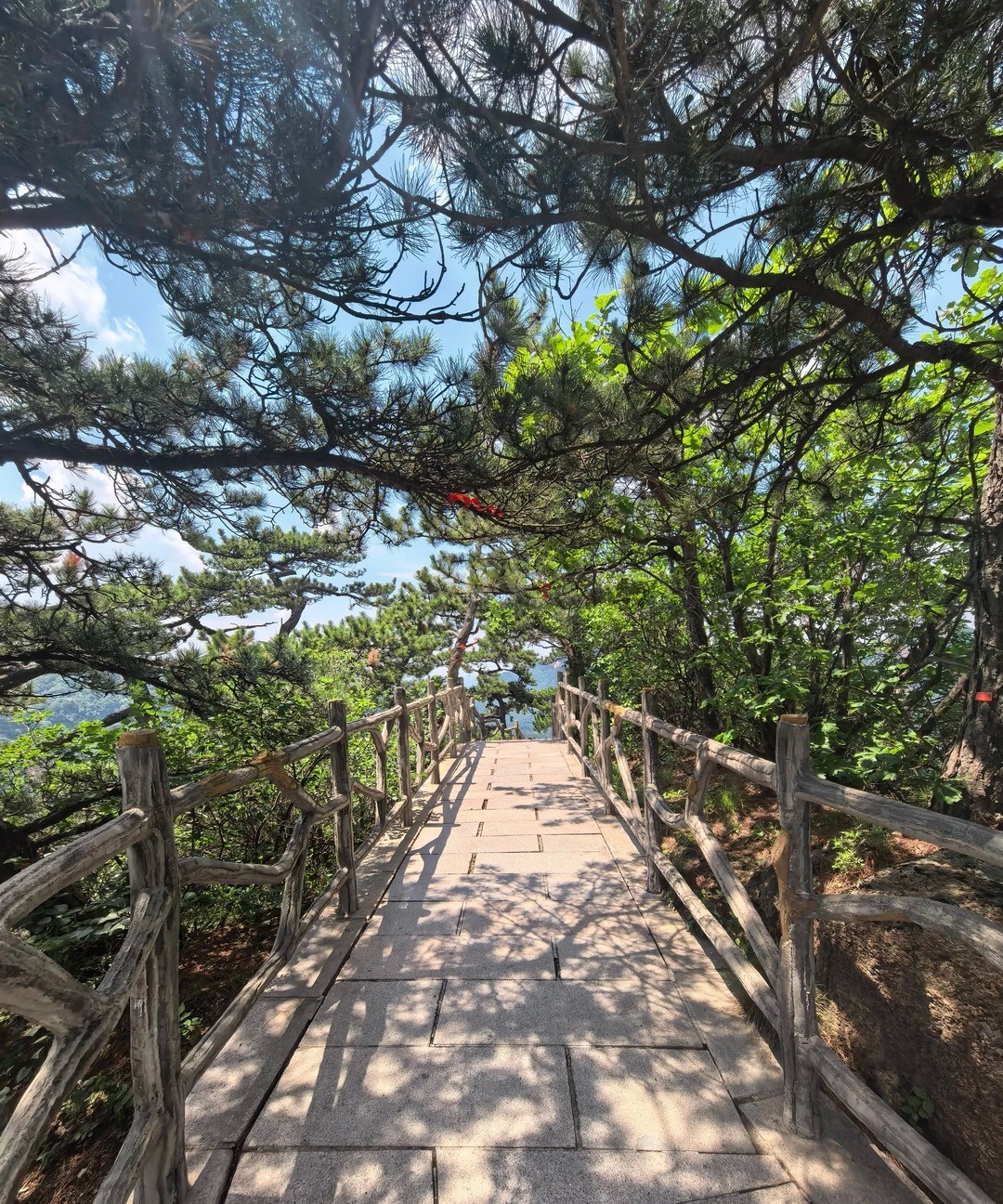
Within Qianshan, the highest peak, Xianrentai, rises to 708.3 meters above sea level and is a superb place to climb for the view. On the mountain, strange rocks are scattered about and temples appear and vanish among the trees; from the summit the peaks roll away in every direction, and the view is extremely wide. The scenic area has a planned area of 125 square kilometers, a touring area of 72 square kilometers and a core scenic area of 44 square kilometers, with mountain paths and plank walkways threading the sights together into a single line. Whether you come for the new green of spring, the red leaves of autumn, the cool of high summer or the snow of winter, Qianshan offers a different prospect each time; along the way pines alternate with rocks and temples are built against the cliffs — walking and pausing, you feel no weariness in your legs, only calm in your heart; the mountain is not high but is secluded, the path is not steep but is long, just right for whiling away half a day.
Qianshan is the place where the Buddhist and Taoist temples of eastern Liaoning are concentrated. The mountain brings together temples of successive dynasties, natural scenery and modern garden art; it has nine Taoist palaces, eight Taoist temples, twelve thatched hermitages and five great Buddhist monasteries, and its incense smoke and morning bells and evening drums have continued for a thousand years. It is famed at home and abroad for the saying that "no peak is without wonder, no rock is without steepness, no temple is without age" and for its lush vegetation — one old saying that captures all the beauty of its rocks and temples. Walking through it, ancient temples and fantastic peaks set each other off, and one walks as if inside a painting, best able to feel the charm of this famous mountain of eastern Liaoning; between morning bells and evening drums, incense and mountain mist rise together, lending this famous mountain an indefinable touch of Zen.
Qianshan's vegetation is excellent, with overall forest coverage of over 98%, and it is known as a natural oxygen bar. It lies around 40° north latitude, where the long chain of mountains forms a natural barrier that shuts out the heat of summer, making it a fine place to escape the heat and cool off. In the mountain, streams run and birds and insects call softly, and the air carries the fresh scent of grass and trees; the saying "eight thousand li to the South Sea, the first mountain of eastern Liaoning" sums up its place among the mountains of eastern Liaoning. Strolling there, your steps slow of themselves and you relax; in summer the mountain wind passes through the woods and the heat vanishes at once, making it the first choice for city dwellers to cool off and while away the summer.
03Matching the scenery o…
Matching the scenery of Qianshan are Anshan's hot springs. Tanggangzi Hot Springs lies 15 kilometers southwest of the urban area and covers 650,000 square meters; it is one of China's four great rehabilitation and physiotherapy centers and the only hot-spring convalescent national 4A-level tourist attraction in the country. The spring water is colorless, odorless, clear and transparent, reaches a temperature of 72 degrees Celsius, and contains more than 30 trace elements including potassium, magnesium, radon and sodium. Soaking in the warm water, the fatigue of travel melts away bit by bit — this is perhaps Anshan's most relaxing side; after a good soak your limbs feel light and even your breathing comes easier, making it one of the great pleasures of a journey; trees cast dappled shadows by the springs, and when you look up from your soak there is green everywhere, and body and mind both loosen.
The hot springs of Tanggangzi have long been more than a soak. Here rehabilitation, convalescence, tourism and holidaymaking are combined into one, and it is one of Anshan's five major tourism brands. Using spring water and hot mineral mud together with massage, acupuncture and other methods has a marked auxiliary therapeutic effect on many chronic illnesses, so convalescents from all over come here year after year, drawn by its reputation. The grounds are quiet and the trees lush; one pool of hot spring water and a patch of green shade are perfect for slowing the pace, staying a few days to restore body and mind, and adding a touch of health-and-wellness to the journey; after your soak you can also listen to the stories of the sanatorium and feel the decades of sediment left by this little hot-spring town; here there are both professional convalescent facilities and courtyards where visitors may stay a while, suited to activity and rest alike.
Besides Qianshan and the hot springs, the Yufo Mountain scenic area is also worth a visit. The area is made up of the Jade Buddha Temple, Eryijiu Park, an amusement park and more, and covers a total area of 17.42 square kilometers. The Jade Buddha Temple was renamed from the Yufo Garden in November 2015 and is the very heart of Yufo Mountain; the parks around it are shaded by green trees and are a fine place for residents to relax. Mountain, temple and park lean on one another: you can enjoy the view, pay respects to the Buddha and take the children to the park — a spot well suited to a family outing; at dawn or dusk the parks fill with residents strolling and dancing, the best way to feel the easy everyday life of Anshan people.
The Jade Buddha Temple is a national 4A-level tourist attraction, lying east of Eryijiu Park at the foot of the Dongshan scenic area, and covers 40,000 square meters. The main hall is 33 meters high, 66 meters wide and 58 meters deep, magnificent in scale; the jade Buddha enshrined in the hall is carved from a "Jade King" weighing 260.76 tons — on the front a 5.23-meter Sakyamuni Buddha, on the back a 2.66-meter Guanyin Crossing the Sea — and is the finest jade Buddha in the world. In 2002 this jade Buddha won a Guinness World Record, making the temple's name known to many more people; a single jade Buddha thus unites warmth and solemnity, unforgettable once seen; the incense is clean and the halls are solemn, and whether or not you believe in Buddhism, you can quiet your mind here.
04Anshan's sights are no…
Anshan's sights are not confined to the urban districts. Within Xiuyan there is Yao Mountain, high and steep with many fantastic peaks; in Haicheng, the Baiyun Mountain scenic area has deep forests and more than 400 peaks large and small; there are also natural wonders such as the Xiuyan meteorite crater. These spots are scattered outside the city and are best reached by self-driving or by hiring a car. If you have time to spare, why not work the surrounding landscape into your itinerary as well, to see the other face of this "steel capital" clearly and to taste the wild charm of the hills of eastern Liaoning; spring flowers, summer cool, autumn red leaves — each patch of mountain and forest has its own bearing and is no less fine than the sights in the city; the mountain roads wind, streams appear and vanish, and along the way you pass stretches of woods and scattered villages.
What sustains Anshan is the rich mineral wealth beneath its feet. Around the urban districts, iron ore reserves exceed ten billion tons, a quarter of the nation's total; its talc mine is one of China's three great sources, with reserves ranking first in the world; and the Xiuyan area has long enjoyed the reputation of "home of jade". Iron and jade, one hard and one soft, mirror exactly the two faces of this city. It is these resources buried deep underground that hold up Anshan's industry and nourish its jade culture, giving the "steel capital" a further, gentler calling card; mining and landscape support each other here, and give Anshan's development an especially solid foundation; from ore to steel, from jade to tourism, this city's family fortune is far thicker than it appears.
In recent years Anshan has also been seeking a balance between landscape and city. It has been named, one after another, a National Civilized City, a National Sanitary City, a National Forest City and an Excellent Tourist City of China, and its appearance keeps being renewed. The old factory districts and the new urban areas exist side by side, so that the city has both the frame of an industrial city and the greenery of a livable one. Walking the streets you see parks, squares and tree-lined avenues everywhere; steel and green trees do not clash but have become this city's distinctive scenery, and make its character all the more vivid; in the interchange of old and new, the city's steps are unhurried, with the composure peculiar to a city of Northeast China.
In Anshan the food is worth noting too. The place is rich in produce, and the table offers both mountain fare and seafood. The Qianshan area grows the Nanguo pear, sweet, clear and juicy, a famous local specialty that has lately often been made into drinks such as milk tea. In the small street eateries, stews, noodles and home-style stir-fries come in generous portions and full flavours, showing the forthrightness of northerners; a meal leaves you steaming and warm, the best comfort for the fatigue of travel and the best way to feel the down-to-earth hospitality of Anshan people; if you come when the Nanguo pears are ripe, basket after basket of golden fruit by the roadside are especially endearing; the locals are warm hosts and always press you to eat a little more, and that sincerity leaves you warm inside.
05Getting around Anshan …
Getting around Anshan is very convenient. As an important city of central Liaoning, it has railways and highways reaching in all directions, and travel to Shenyang, Dalian and elsewhere is smooth; buses cover the main sights within the city, a dedicated bus runs from downtown to Qianshan, and shuttle buses reach Tanggangzi as well. Base yourself in the urban districts and both getting around and finding food are easy. If you drive yourself, moving between the scenic areas is more flexible still, and you can take in the mountain, the springs and the temple all in a single day, arranging the trip at leisure; whether by train or by car, Anshan is easy to get in and out of, and fits neatly into a linked itinerary of southeastern Liaoning.
In Anshan, three to four days will let you see things at a comfortable pace. On the first day, tour the urban districts and see the Jade Buddha Temple, Eryijiu Park and the look of the city; on the second day, go up Qianshan to climb, pay respects to the Buddha and admire the fantastic peaks and ancient temples, returning well content; on the third day, go to Tanggangzi to soak in the hot springs and take a course of convalescent treatment, letting body and mind relax; on the fourth day, if you still have room, you can go out to Yao Mountain and Baiyun Mountain nearby for the wild charm of forest and hill. Follow such a route and you take in all four of mountain, springs, jade and steel, at a gentle pace as well; if you have only two days, you can put the emphasis on Qianshan and the hot springs and save the other sights for next time; and if you come in high summer, you might schedule the climb for early morning and return to the city to rest in the afternoon, avoiding the hottest hours of the day.
If time is short, a single day can still catch the essence of Anshan: in the morning climb Qianshan, choosing a classic route to see Xianrentai and several ancient temples; in the early afternoon turn to the Jade Buddha Temple to see that jade Buddha, the finest in the world; towards evening go to Tanggangzi for a soak in the hot springs and round off the day with a pool of hot water. If you love nature, you can give the whole day to Qianshan, walking slowly and looking closely; if you prefer to take your ease, you may give more of your time to the hot springs and the parks, each to his own pleasure, and neither will disappoint; in a word, Anshan can be enjoyed moving or resting, climbing mountains and fording streams or soaking in the springs to restore the spirit — it all depends on your own preference.
Anshan has four clearly distinct seasons, each with its own way to be enjoyed. In spring the mountain flowers bloom in profusion, a good time to climb Qianshan and see the new green; in summer the mountain is cool and the woods are lush, a fine time to escape the heat; in autumn the sky is high and the air crisp and the hills are covered with red leaves, one of the loveliest seasons in Qianshan; in winter you can soak in the hot springs and watch the snow beyond the window, cold and warmth complementing each other. Whichever season you come, pairing Qianshan with the hot springs will always let you find a rhythm that suits you, and will not waste this landscape — the city can be visited in any season; mountain and springs, one cold and one hot, complement each other perfectly, so that even a winter visit is not without its delights; and if you want to catch good weather, spring and autumn are the safest, neither cold nor hot, just right for climbing and soaking.
06There is no need to pa…
There is no need to pack the itinerary too full. Half of Anshan's charm lies in its famous scenic areas and half hides in ordinary streets and lanes: the old people doing morning exercises in the parks, the little shops steaming by the roadside, the lights coming on at dusk — all are the city's true everyday life. Leave yourself a little time to wander; stroll in Eryijiu Park, or simply find a hot-spring hotel and stay a night — it is then easier to remember Anshan, and easier to meet surprises you had not planned for; travel need not be a rush from one stop to the next, and when you are tired, rest; sit a while in a park, taste a bite of hot food in a little shop — the pleasure of travel is often hidden in just such inconspicuous moments.
Anshan's virtue lies in the coexistence of firmness and gentleness: on one side the memory of steel written by blast furnaces and factory grounds, on the other the peaks of Qianshan, the hot springs of Tanggangzi and a warm jade Buddha. It is in no hurry to show visitors anything; you need only climb Xianrentai once and soak in the hot water once to read the weight of this "steel capital". Bring comfortable shoes and set aside time for the hot springs, and Anshan will give you an unhurried answer of its own and let your rhythm slow of itself; give your time to the mountains and the springs, and the beauty of Anshan will emerge bit by bit and stay in your memory; there is no need to hurry — climb a mountain and soak in a spring, and the trip will already have been worth it.