01Benxi City lies in sou…
Benxi City lies in southeastern Liaoning Province, a city known for its iron and steel industry and embraced by forests and maple leaves. It is also a China Excellent Tourist City and a National Forest City, with a total area of 8,414 square kilometers and forest coverage of 76.31%. Benxi administers two Manchu autonomous counties, Benxi and Huanren, and four urban districts, Pingshan, Mingshan, Xihu and Nanfen, with a registered population of 1,347,000; it is a city where many ethnic groups live together. This is an old industrial base of Liaoning: Benxi Iron and Steel has a history of a hundred years and is called the "cradle of China's steel industry", and its steel was used in the first batch of rifles, the first cannon, the first Jiefang-brand motor vehicle and 18 products of "China's firsts" that New China designed and built itself. Benxi is likewise an ecological city, with forest coverage ranking first in Liaoning; within its territory are 251 rivers and 23 reservoirs, making it the "water tower" of Liaoning. Benxi Water Cave and Huanren's Wunü Mountain, two national 5A-level scenic areas, each excel in its own way, one a cave and one a mountain. It claims six calling cards — "wondrous caves, famous mountains, beautiful waters, hot springs, maple leaves and folk customs" — and has long been known as the "Maple Leaf Capital of China" and the "Hot Spring City of China"; the red maples of autumn and the hot springs of winter are the city's two most moving faces. Three to four days are enough to see the caves, climb the mountains, admire the maples and soak in the springs, and to slowly come to understand this city where landscape and steel interweave. A city with both industrial sinew and natural spirit, it is worth slowing down to savour.
Benxi City lies in southeastern Liaoning Province, at the meeting point of the eastern offshoots of the Changbai Mountains and the hills of eastern Liaoning. It has a temperate humid monsoon climate with four clearly distinct seasons. The city covers a total area of 8,414 square kilometers and administers two Manchu autonomous counties — Benxi and Huanren — and four urban districts, Pingshan, Mingshan, Xihu and Nanfen, with a registered population of 1,347,000. The whole city is shaped like the mathematical sign for "infinity", its two wings spread wide, with mountains, water, caves, springs and lakes set among the hills and valleys; forest coverage reaches 76.31%, the highest in Liaoning, and it has long been known as a "natural oxygen bar and ecological oasis". After every rain the mountains are wreathed in mist, the river valleys turn damp and the city's air grows clear and especially refreshing.
Benxi is an old industrial base that rose on steel. Benxi Iron and Steel, with a history of a hundred years, has been called the "cradle of China's steel industry" and a "meritorious enterprise of the Republic"; its steel was used in the first batch of rifles, the first cannon, the first Jiefang-brand motor vehicle and the first recoverable satellite that New China designed and built itself, among 18 landmark products of "China's firsts". In 2021 Benxi Iron and Steel completed its reorganization with the Ansteel Group, and today it offers more than 60 product varieties and over 7,500 specifications. Wandering through the city, the Benxihu industrial heritage complex stands in silence; it is a Major Historical and Cultural Site Protected at the National Level and was also listed in the first batch of national industrial heritage sites. These industrial remains have now been revitalized into exhibition halls and cultural-creative spaces, allowing visitors to touch the bygone glory of this steel city.
Benxi is the only national geopark in China named after the city, with striking geological features. It boasts six calling cards — "wondrous caves, famous mountains, beautiful waters, hot springs, maple leaves and folk customs" — and was also an important base of the Northeast China Anti-Japanese United Army. Here are the UNESCO World Cultural Heritage site of Wunü Mountain City, Asia's largest natural water-filled karst cave, Benxi Water Cave, as well as a group of well-known scenic areas such as Guanmen Mountain, Tiesha Mountain and the Grand Canyon. The city has 51 A-level scenic areas in all: two 5A-level, 13 4A-level, 21 3A-level and 15 2A-level. From the cave heavens of remote antiquity to the mines and factories of modern times, from Taoist mountains to the customs of the Manchu people, Benxi's stories pile up layer upon layer, enough to be savoured slowly.
02Benxi Water Cave is th…
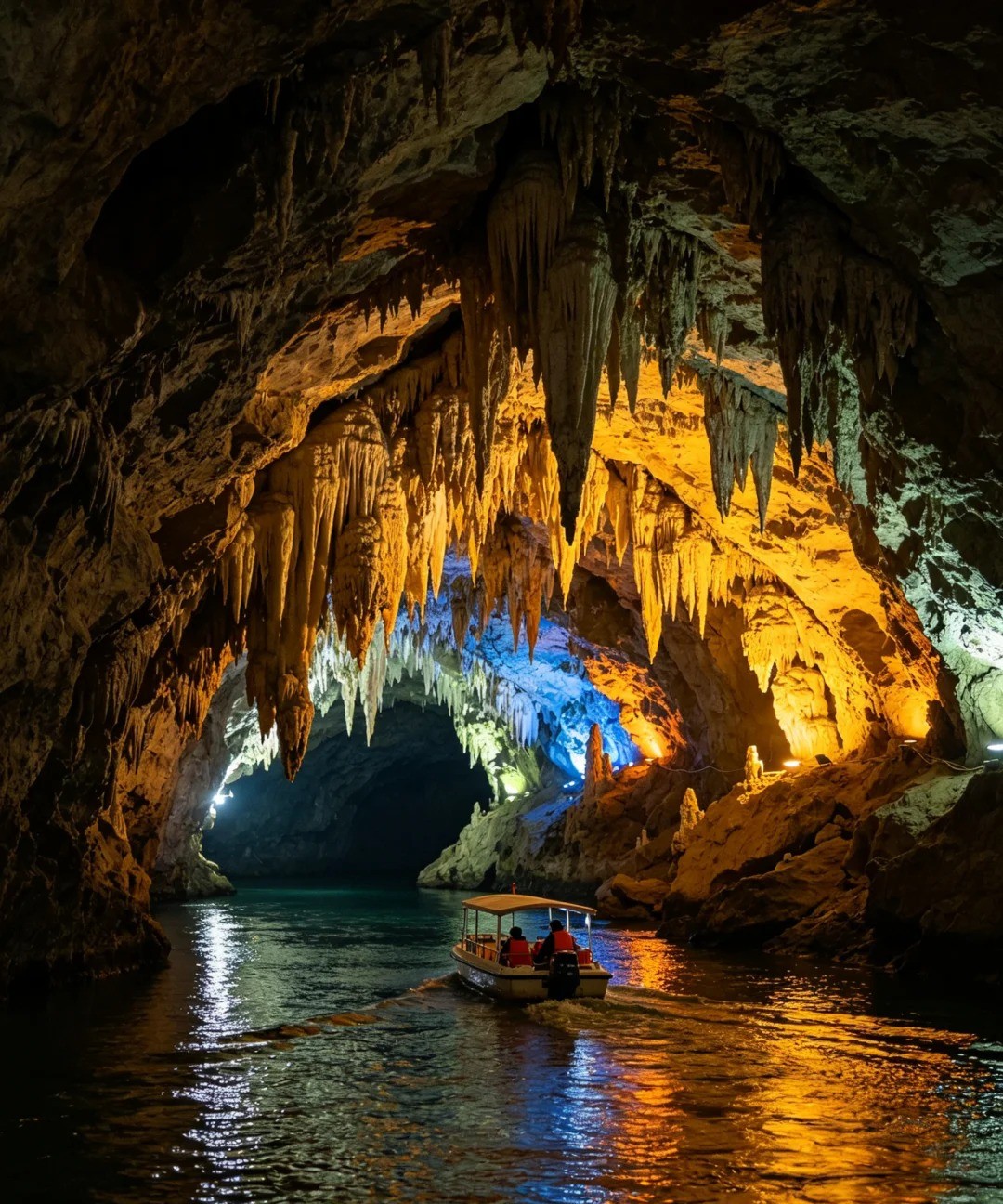
Benxi Water Cave is the best-known wonder in Benxi, a national-level scenic area and one of the first batch of national civilized-tourism demonstration units. It is chiefly a karst cave with an underground river, bringing together mountains, water, caves, springs, lakes and forests in one place. The cave is 5,800 meters long in total, of which 2,800 meters have been opened up; its temperature stays at 12 degrees Celsius year-round and the water never runs dry. On both banks stalactites hang high and stalagmites stand in ranks, and drifting by boat through them feels like entering a fairy realm. In June 2018 the site was certified by a world-record authority as "the world's longest underground river scenic area open for continuous boat excursions". Every winter, rime frost often forms around the area in front of the cave, making it a sight not to be missed on a winter visit. Slip into the cave in a small boat and cool air rushes over you as light and shadow play across the stalactites, as if you had entered another world beneath the ground.
The Wunü Mountain scenic area is a UNESCO World Cultural Heritage site, located 8 kilometers northeast of the seat of Huanren Manchu Autonomous County. Its core zone covers 10.8 square kilometers and consists of three parts: the Wunü Mountain City ruins display area, a natural landscape area and the Wunü Mountain Museum. It was included in the national forest park list in 1991, was designated a Major Historical and Cultural Site Protected at the National Level in 1996, was chosen as one of China's ten major new archaeological discoveries in 1999, entered the World Cultural Heritage list in 2004, was approved as a national geopark in 2005 and was rated a national 5A-level tourist attraction in 2024. As an important mountain-city site, Wunü Mountain City is both an archaeological treasure and a superb viewing platform for overlooking the surrounding countryside; standing on the city walls and gazing into the distance, the whole lovely prospect unfolds before your eyes.
Guanmen Mountain National Forest Park has long been known as "the Little Huangshan of Northeast China", with forest coverage of 95%. Inside are five major scenic areas — Little Huangshan, Jialazi, Longmen Gorge, Yuetaizi and Mingcui Valley — and 108 scenic spots; it is one of Liaoning's fifty best scenic areas and combines sightseeing, summer holidays, leisure and revolutionary education in one. In spring you see ten thousand blooms, in summer the green hills and clear waters, in autumn the tiered forests dyed through, and in winter jade-like trees and crystal blossoms; autumn especially, when the red maples blaze like fire in a riot of colour, takes your breath away. The park also preserves several old sites of secret camps of the Anti-Japanese United Army, where barracks and hidden storehouses can still be made out. The trails through the hills are gentle, streams murmur, and birdsong never ceases; whether you are out with children or climbing with friends, everyone finds their own pleasure.
Fenglin Valley Forest Park has forest coverage as high as 98.75%. Its highest peak, Bamianwei, rises 1,305 meters, and the park is a forest-ecology tourist area combining red-leaf viewing, summer holidays and leisure and health care. The climate here is cool and pleasant, with an average midsummer temperature of around 20 degrees Celsius and extremely high negative-oxygen-ion levels; it has been called "the place best suited for breathing" and is a veritable "natural oxygen bar". The scenic area's maple leaves come in a complete range of varieties, are widely distributed, turn fiery red early, are brilliant in colour and last a long time — arguably China's finest maple foliage. After the autumn frost, ten thousand hills turn red and tiered forests are dyed through; this is the far-famed "kingdom of maple leaves", and the site of the Bamianwei anti-Japanese guerrilla base is also preserved in the mountains. Strolling along the boardwalks among the trees, the mountain breeze carries the fresh scent of grass and wood to your face, and the summer heat and worries are left far behind.
03The Guanshan Lake tour…
The Guanshan Lake tourist area combines mountains, water, maples, lakes and boats in one, and is a national water-conservancy scenic area. Its forest coverage is over 97.5% and its negative-oxygen-ion levels are rich, and it has long been known as a "Little Huangshan" and a "Little Guilin". The area is divided into four distinctive zones — "Red Leaf Lake boat sightseeing", "Jingxiu Peak climbing for the view", "Biquan Valley secret-realm exploration" and "Maple Flower Island lakeside wandering" — and offers 40 scenic spots including the Golden Toad Pool and the Dragon Garden, plus such activities as lake cruises, kayaking, campfire barbecues and RV camping. In summer, boating on the lake, greenery on both banks rushes up to greet you; in autumn the maple leaves are mirrored in the water, and the boat seems to glide into a flowing oil painting.
The Dashi Lake scenic area is made up of two parts, Dashi Lake and Laobiangou, a fusion of rock and forest, mountain and spring, famous for the saying "wondrous Dashi Lake, graceful Laobiangou". Dashi Lake is divided into four touring zones — Wulong Lake, Bingling Gorge, Xiangshui Lake and Mulan Valley — while Laobiangou consists of three: Yongge River, Stone Array Slope and Wanxiang Valley. This is a national geopark, a national land-and-resources science-popularization base and one of Liaoning's fifty best scenic areas; it is famed far and wide for maple leaves that "dye the tiered forests through on five-coloured flowered mountains", and it is an important scenic area on the China Maple Leaf Road and the eastern Liaoning corridor. Several battle sites of the Anti-Japanese United Army are also preserved within Laobiangou. Walking along the river, the sound of water mingles with the soughing of the forest; the ravines are deep, the rocks grotesque, and every step brings a new view.
Dabinggou Forest Park has forest coverage of 97% and is a fine place to escape the heat and cool off, and to rest and keep well. The scenic area's groundwater stays at around 4 degrees Celsius year-round; its flora and fauna are rich, making it a "natural oxygen bar" for leisure and health, and a destination for eco-tourism, holiday leisure and exploratory study. Here there are summer ice-fall spectacles rarely seen at low elevations in the world's temperate zone, groves of the world-endangered Tiannu magnolia, and the finest multi-lobed red maple leaves, rarely found in China. In golden autumn, maple leaves across the hills vie in splendour, ten thousand mountains turn red and tiered forests are dyed through; this is also a place where red memory is carried on.
The Wangtian Cave is known as "the first cave of the North, with a labyrinth unmatched in the world". Its passages formed 200,000 years ago and have developed into corridor-like, hall-like and labyrinthine forms, with extraordinary karst scenery that combines scientific value with visual appeal. Nearly 10 kilometers of the Wangtian Cave have been surveyed so far, of which 2,100 meters are open; the cave ranks first in China for the number of miniature stone terraces and the variety of rimstone dams, and its stalactites grow faster than anywhere else in the country, while its thin, translucent "stone flags" are rarely seen in China. Step inside and above your head are jagged rock walls and deep fissures, while underfoot the walkway is wet and slippery; the labyrinth is especially rare in the world, its explored passages totalling 1,100 meters, so regular they seem to have been carved by human hands, to everyone's amazement.
04Tiesha Mountain is the…
Tiesha Mountain is the birthplace of the Longmen sect of Taoism in Northeast China, and has long enjoyed the reputation of "a thousand-year gathering place of immortals, the first Taoist mountain of Northeast China". It forms part of the Changbai Mountains and consists of five main peaks — Yuhuang Peak in the east, Wenshi Peak in the south, Nanhua Peak in the west, Zhenwu Peak in the north and Taiqing Peak in the centre — three threes making nine, which is how it came to be called "Nine-Peak Tiesha Mountain". The mountain holds many rock caves, the most famous being the Babao Yunguang Cave, where verses inscribed by visitors over the ages and stone carvings are seen everywhere; carvings such as "sharing the longevity of heaven" and "the righteous spirit of the cosmos" are bold and vigorous in brushwork. Climbing to the summit, clouds and mist surge below your feet, distant hills lie like dark eyebrows, the Taoist temple is quiet and secluded, and the faint sound of bells and chimes can be heard — an otherworldly mood all its own.
The Benxi Grand Canyon is a national geopark, positioned around the theme of "thrills and adventure". On top of its high-altitude glass suspension bridge and forest slide, the scenic area has opened a series of amusement attractions such as a high-altitude flying wing, a sky walk, a cliff swing and a seven-coloured cloud water slide, giving visitors the thrill of a racing heartbeat. The canyon's high-slung horizontal glass suspension bridge is praised as the finest in Northeast China; walking on it and looking down into the deep gorge, with vast emptiness below your feet and layered ridges before your eyes, the danger only makes the rivers and mountains feel more magnificent. Beyond the exciting rides, the canyon's own landscape is well worth a closer look, with strange peaks facing one another and streams winding along; thrills and beauty coexist here in a wondrous way.
Xiaoshi Yizhuang, not far from Benxi Water Cave, is a bright spot in Benxi's rural tourism. The scenic area stands in Tongjiangyu Village, Xiaoshi Town, Benxi Manchu Autonomous County, only 1 kilometer from the national 5A-level Benxi Water Cave. Drawing on its mountain-and-water resources and themed around "experiencing folk customs, enjoying green hills and clear waters, and tasting distinctive foods", it has built a rural-tourism scenic area that combines leisure travel, countryside holidays, dining and entertainment, cultural performances and ecological health care, and it is a "national pilot unit for the integration of culture and tourism" and a "model rural-tourism destination". By the end of 2024 the city had 32 national- and provincial-level key rural-tourism villages and towns and 258 star-rated farmhouse inns. Stay here a night, watch the cooking smoke rise and listen to the dogs bark and cocks crow, and the clamour of the city seems shut out beyond the mountains in an instant.
Benxi is known as the "Maple Leaf Capital of China", and admiring the maples is the great event of autumn here. The city tree of Benxi is the maple; its maple leaves are extremely varied, from three-pointed and five-pointed to thirteen-pointed, and the area for viewing them is vast. Late September to mid-October each year is the best viewing period, and more than a dozen viewing spots — Guanmen Mountain, Dashi Lake (Laobiangou), Fenglin Valley, Wunü Mountain, Tiesha Mountain, Dabinggou and the China Maple Leaf Road — together form scene after breathtaking "maple view". Drive yourself along the China Maple Leaf Road and red leaves line the way, with nothing but mottled autumn colour outside the car window; once the autumn frost has touched them, ten thousand mountains turn red and tiered forests are dyed through, and the hills of Benxi become a scroll of intense colour.
05Benxi is a Hot Spring …
Benxi is a Hot Spring City of China, rich in hot-spring resources; in winter, "playing in the ice and snow, soaking in hot springs, watching ball games and celebrating the New Year" has become a way of life. Hot springs such as Huaximu and Fengxiang Valley link ice-and-snow fitness, hot-spring health care, traditional Chinese medicine therapy and folk-custom experiences together, meeting the different needs of visitors. On days when the chill deepens, soak in a pool of hot water and watch the snow settle on the mountain forests outside the window, and the weariness of the journey melts away. Besides admiring maples in autumn and soaking in springs in winter, Benxi's summer is just as pleasant: the mountains are cool and the lake waters clear, making it a fine place to escape the heat, while hot springs and maple leaves — one warm, one brilliant — have become Benxi's two most recognizable calling cards.
Benxi was an important base of the Northeast China Anti-Japanese United Army, the main base for the activities of its First Army, and one of the important cradles of the Northeast China Anti-Japanese Volunteer Army. In scenic areas such as Guanmen Mountain, Dashi Lake (Laobiangou), Fenglin Valley and Dabinggou, secret camps, battle sites and hidden storehouses of the United Army still survive, and the Exhibition Hall of Historical Facts of the Northeast China Anti-Japanese United Army and the Memorial Hall of the Northeast China Anti-Japanese Volunteer Army are national patriotism-education demonstration bases. Site after site silently tells of the hard years amid the white mountains and black waters of that time, and adds a weighty layer of homeland feeling to Benxi's landscape, so that beyond enjoying the scenery one also receives a profound red baptism.
Benxi is the green corridor of eastern Liaoning and an important ecological shield and water source for Liaoning. Forest coverage across the city is 76.31%, the highest in the province; within its territory are 251 rivers and 23 reservoirs, with a total capacity of more than 6 billion cubic meters, including the province's largest and third-largest reservoirs, supplying water to 13 prefecture-level cities in the province — which is why it is called the "water tower" of Liaoning. Its proportion of days with good air quality and its water-quality index have long ranked among the top two in the province, with green hills, clear waters and fresh air. This exceptional ecology lets Benxi please both the eye and the body; whether climbing hills, playing in the water or simply resting, through the turning of the four seasons there is everywhere a calm ease in being with nature.
Benxi's products and culture are just as rich. Across its territory there are 1,117 kinds of medicinal herbs, and northern medicinals such as Acanthopanax senticosus, Liaoning wild ginger and Liaoning schisandra are renowned at home and abroad, with sizable under-forest herb bases centred on under-forest ginseng. As for minerals, eight major categories and 46 kinds have been found, including iron ore, quartz, limestone and calcite, accounting for 38% of the province's known minerals; proven iron-ore reserves stand at 10.812 billion tonnes, the largest in the province. The Liaoning inkstone, famous in the world of calligraphy-and-painting collectors, was once a tribute to the Liao and Qing courts, while folk arts such as shehuo performances, paper-cutting and woodblock prints reflect the city's distinctive ways. On your travels, do try Xiaoshi mutton soup, wild mountain vegetables and a whole-fish banquet, and take home a bottle of Huanren icewine — mountain produce, medicinal herbs and good wine preserve, one by one, the flavours of the season.
06Benxi lies in southeas…
Benxi lies in southeastern Liaoning Province, with Shenyang and Fushun to the north, Dandong to the south, Liaoyang to the west and Tonghua in Jilin to the east. It is an important node city of the Shenyang economic zone and an important transport hub in southeastern Liaoning Province. It is 62 kilometers from Shenyang, and expressways and railways interweave within its territory, making travel very convenient. If you have the time, plan for three to four days: first see Benxi Water Cave and Wunü Mountain, then tour Guanmen Mountain and Fenglin Valley to admire the maples, and finally stop at Xiaoshi Yizhuang to rest and soak in the springs. Spring brings mountain flowers, summer escapes the heat, autumn offers red maples and winter hot springs; whenever you come to Benxi, you can gather its caves, mountains, maples and springs into your journey one by one.