01Yantai lies in the eas…
Yantai lies in the eastern part of the Shandong Peninsula, on the shores of the Yellow Sea and the Bohai Sea; covering 13,900 square kilometers of land with a 1,071-kilometer coastline, it is a northern coastal city where fairy legends, treaty-port memories and harbor charm are layered together. The city takes its name from the wolf-smoke beacon towers built on Beishan by the sea during the Hongwu era of the Ming dynasty; after it opened as a treaty port in 1861, it became one of the earliest treaty ports of northern China, where 17 countries successively established consulates and left behind swathes of modern Western-style buildings. Yantai's most celebrated sight is Penglai Pavilion, built in 1061, the sixth year of the Jiayou era of the Song dynasty; it ranks alongside Yueyang Tower, Yellow Crane Tower and Tengwang Pavilion as one of the four great towers of ancient China, and the legend of the Eight Immortals crossing the sea and the spectacle of the mirage lend it an air of the ethereal. At its foot, Penglai Water City is the best-preserved ancient naval base in China. North of Penglai Pavilion lies Changdao, whose 151 islands line the Bohai Strait from south to north; migratory birds, spotted seals and sea delicacies have made it a national nature reserve and a national 4A-level tourist attraction. In the city proper are Yantai Hill, Chaoyang Street and Suochengli, one hill and two streets stringing together the twin memories of the treaty port and the coastal garrison; north of Muping, Yangma Island is made for cycling, while the Mou Family Manor in Qixia is the largest landlord's manor in northern China. The city is also a wine and apple region, and sea intestine rice, Yantai menzi, Spanish mackerel dumplings and Penglai noodles make up its most everyday flavors. At the end of 2025 the city had a permanent resident population of 7,000,500; the climate is mild around the turn of summer and autumn, a fine time to see the sea and taste it.
Yantai sits at the eastern end of the Shandong Peninsula, facing the Yellow Sea and the Bohai Sea and looking across the water toward the Liaodong Peninsula and Japan, South Korea and North Korea. The city covers 13,900 square kilometers of land, has a 1,071-kilometer coastline and 230 islands, and its terrain is dominated by low mountains and hills; its highest peak, Taibo Peak of Kunyu Mountain, rises 922.8 meters. At the end of 2025 the city had a permanent resident population of 7,000,500 and administers five districts and six county-level cities. The sea lies to the north of the city, and also to its east, so both sunrise and sunset can be seen over the water — an urban layout rarely seen in Shandong.
Yantai is one of the early cradles of ancient Chinese civilization. As far back as the late Pleistocene, human beings were already living and multiplying here; 7,000 years ago, the Neolithic Baishi culture arose on this land. In ancient times it was the land of the Eastern Yi people, who founded a state here during the Xia dynasty; in the Shang, Western Zhou and Spring and Autumn periods it was the land of the state of Lai, and in the Warring States period it belonged to Qi. Under the Qin it fell within Qi Commandery, under the Han it was Donglai Commandery, under the Sui it was Laizhou, under the Tang, Song and Yuan it was Dengzhou and Laizhou, and under the Ming and Qing, Dengzhou Prefecture and Laizhou Prefecture. In 1398, to strengthen coastal defenses, the Ming government established the Qishan Garrison here and built a beacon tower on Beishan, known as a "wolf-smoke beacon" (langyantai), from which Yantai took its name — this was also the earliest embryonic form of the city of Yantai.
The opening of the port in modern times changed the course of the city. In 1858 the Qing government signed the Treaty of Tianjin with Britain, France and other countries, designating Dengzhou a treaty port; in 1861 the treaty port was fixed at Yantai. Thereafter 17 countries including Britain, France and the United States successively set up consulates in Yantai, and trading houses, banks, post offices and clubs arose in their wake. After the founding of the People's Republic of China, the Wendeng and Laiyang Special Districts and the provincial-level Yantai City were established in 1950, the Yantai Special District was set up in 1958, and the prefecture-level Yantai City was founded in 1983. From Suocheng to treaty port, from fishing harbor to seaport, nearly all of Yantai's modern history is written along this stretch of coastline.
02No account of Yantai c…
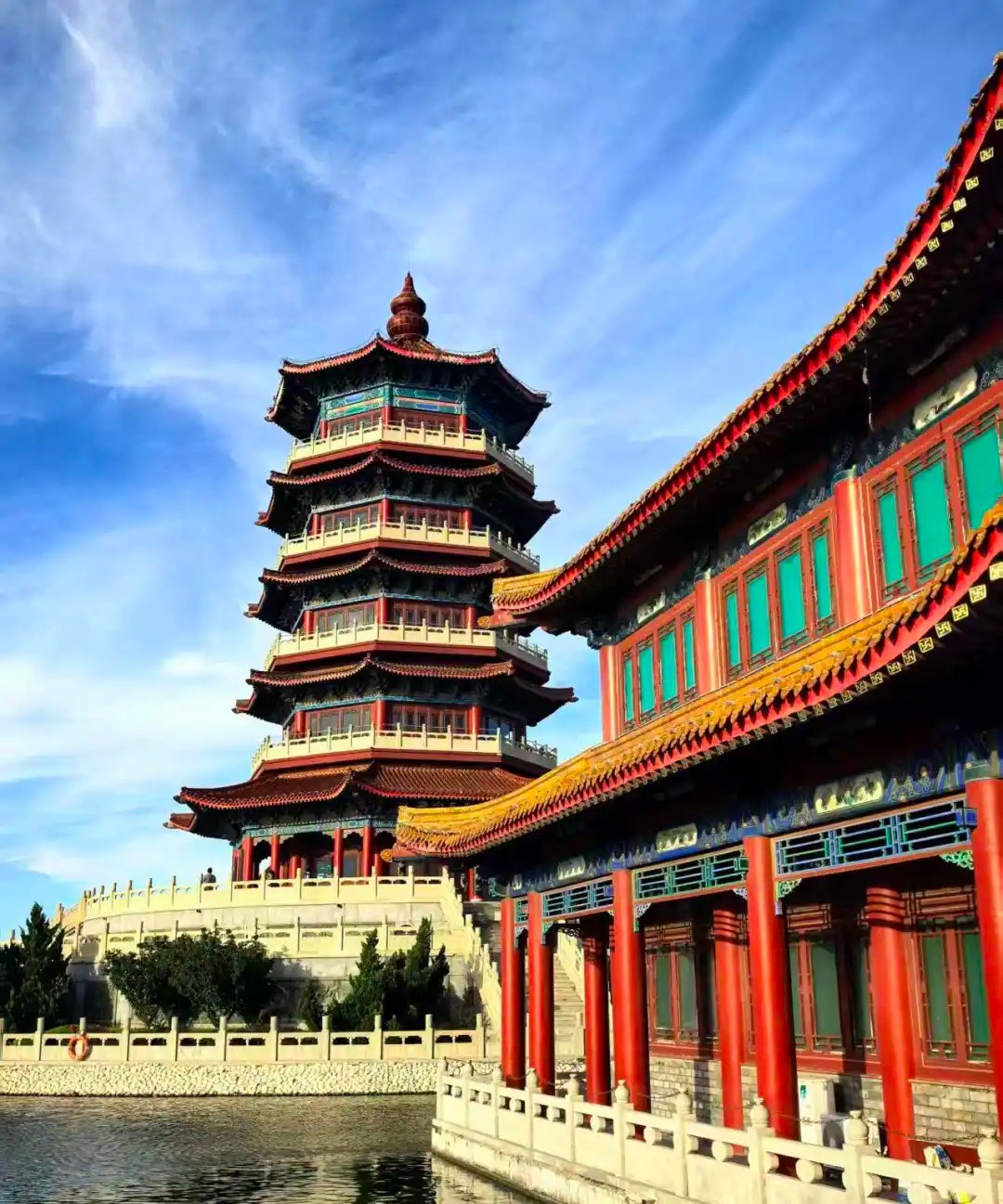
No account of Yantai can leave out Penglai Pavilion. It stands on the summit of Danya Cliff, facing the open sea. Built in 1061, the sixth year of the Jiayou era of the Song dynasty, Penglai Pavilion ranks alongside Yueyang Tower, Yellow Crane Tower and Tengwang Pavilion as one of the four great towers of ancient China. The pavilion group follows the lie of the hill and mirrors the boundless blue sea; when clouds and mist swirl about it, it truly evokes the mood of "an immortal pavilion hovering in the sky." This is also the fountainhead of the legend of the Eight Immortals crossing the sea — the story goes that the Eight Immortals each took up their treasured implements and sailed across the ocean from this spot. As for the "mirage," it is a wonder one can only hope, but not count, to meet; the great Song literary master Su Dongpo captured its realm in the lines "Empty again and again, the clouds and seas of the east, where throngs of immortals appear and vanish in the luminous void."
Today's Penglai Pavilion is not an isolated tower but a scenic area covering 10.5 square kilometers. Taking "mountain," "sea," "city" and "pavilion" as its framework, it embraces more than 20 sights, including the ancient building complex of Penglai Pavilion, Penglai Water City, the hometown of Qi Jiguang and Tianheng Hill, fusing natural scenery and historic monuments in one. The ancient building complex consists of six groups of structures — Penglai Pavilion, Tianhou Palace, the Dragon King Palace, the Sanqing Hall, the Lüzu Hall and the Mituo Temple — with more than 100 halls, terraces and pavilions, Daoist temples and Buddhist monasteries sharing one ground. Open since 1980, the scenic area has become a scenic resort integrating natural scenery, historic monuments and cultural landscapes, and is among the first group of national 5A-level tourist attractions.
The Water City at the foot of Penglai Pavilion deserves a close look as well. Also called the Beiwu (Barbarian-Resisting) City, its predecessor, the ancient port of Dengzhou, was named alongside Mingzhou, Yangzhou and Quanzhou as one of the four great ports of ancient China. In 1376, the ninth year of the Hongwu era of the Ming, it was built up into a fortified city on the foundations of the old "Diaoyu (Knife-fish) Camp," with towering walls and staggered enemy platforms; a water gate to the north controlled the movement of ships at sea, floodgates were set within, batteries stood on both sides and garrison troops kept watch — a defensive system that could advance to attack and withdraw to hold. The famous anti-pirate general Qi Jiguang once held command here, and the city has restored Ming military installations such as the Beiwu Dusi Office, barracks and parade grounds. It was a coastal-defense stronghold of the Ming and Qing dynasties, and it is the best-preserved ancient naval base in China.
Sailing north from Penglai Wharf, you enter Changdao. Also called the Miaodao Archipelago, Changdao lies between the Jiaodong and Liaodong peninsulas at the meeting of the Yellow Sea and the Bohai Sea; its 151 islands run north to south through the Bohai Strait, 10 of them inhabited. The islands cover 59 square kilometers of land with 3,541 square kilometers of sea around them and a coastline of 187.8 kilometers; it is 7 kilometers south of Penglai and 42 kilometers north of Lüshun. It administers eight townships (towns and sub-districts) and 40 administrative villages, and at the end of 2025 the total population of the district was 39,000. The waters around the islands are remarkably clear, and they have long been known as "fairy mountains on the sea" and a "natural oxygen bar."
03Changdao's climate kee…
Changdao's climate keeps an island's own measure. The annual mean temperature is 11.9 degrees Celsius, the annual average precipitation is 560 millimeters and forest coverage is 60%, with air of national Grade I quality and sea areas of Class I water quality. More moving still are the migratory birds and sea mammals: each year more than 320 species and over 1.20 million migratory birds pass through — 24% of all species in China — and nearly 400 Pacific spotted seals rest here annually. Islets, wetlands and migratory birds form a complete migration corridor, and they have made the islands a national nature reserve and one of China's ten most beautiful islands; it is now a national 4A-level tourist attraction.
The sea of Changdao also nourishes its people. The surrounding waters abound with 217 species of shellfish, algae and fish delicacies, and they are the native home of such sea treasures as the prickly sea cucumber, the wrinkled abalone, the Zhikong scallop and the globe sea urchin; the area has been named China's Home of Abalone, China's Home of Scallops and China's Home of Kelp. In 2018 the Shandong provincial government approved the establishment of the Changdao Marine Ecological Civilization Comprehensive Pilot Zone; in 2020, the State Council approved the dissolution of Penglai City and Changdao County to establish Penglai District, with Changdao operating independently under a provincial-level marine ecological civilization functional-zone system. Staying in a fishing household on the islands, following the fishing boats out of the harbor at dawn and eating freshly landed shellfish and fish in the courtyard at dusk is the plainest of island pleasures.
Back in the city proper, Yantai Hill is the gateway to understanding this city. At the northern end of the urban area and surrounded by the sea on three sides, it covers 45 hectares and rises to 42.5 meters at its highest point — a Major Historical and Cultural Site Protected at the National Level and a national 4A-level tourist attraction that combines coastal natural scenery, treaty-port culture, cultural relic sites and exotic charm. In 1398, the thirty-first year of the Hongwu era of the Ming, a "wolf-smoke beacon" was built on the summit, and from it Yantai Hill and the city of Yantai took their names. After the port opened, 17 countries successively established consulates, trading houses and villas on and around Yantai Hill; the hill still preserves the former consulates and attached office buildings of six countries — Britain, France, the United States, Germany, Denmark and Japan — more than 30 buildings in all, forming the most complete and most densely clustered group of modern foreign consulates in Asia.
The lighthouse on the hill, built in 1988 and 49.5 meters tall, is the city landmark in the hearts of Yantai people; shaped like an upturned conch, its observation deck commands a full view of Zhifu Bay. Down the hill and eastward lies the old street district of treaty-port culture. The Chaoyang Street Historical and Cultural District covers about 42 hectares with a total floor area of 290,000 square meters and 77 protected historic buildings, making it one of the best-preserved surviving treaty-port building complexes in the country; the main street, Chaoyang Street, runs 400 meters, lined mostly with the former premises of modern trading houses and merchants — today a fine place for a stroll and a bite to eat.
04Facing Chaoyang Street…
Facing Chaoyang Street across the way is Suochengli, the birthplace of the city of Yantai. In 1398, the thirty-first year of the Hongwu era of the Ming, the "Qishan Garrison Thousand-Household Post" was established here to guard against pirate raids; the guard posts were abolished in the Shunzhi era of the Qing, and in the third year of the Kangxi era the Qishan She was set up, the area gradually becoming a residential settlement for descendants of the garrison and military households. The district covers about 9.9 hectares and still largely preserves its overall layout from the Ming and Qing through the early Republic: the "cross streets" laid out on the plan of a defensive walled town, together with the troop horse-paths within the walls, survive to this day as lanes and alleys, and the district contains 262 intact heritage courtyards.
Yangma Island off the north of Muping District is another, easier-going island scene. It covers 14.9 square kilometers of land and 53.2 square kilometers of sea, with an island shoreline 22.9 kilometers long, and administers eight administrative villages. It is famous for its unique "one island, three beaches" terrain: in front of the island lies a product-rich black-mud flat, at its eastern end a shallow, fine-sand golden beach, and behind it a rocky shore strewn with reefs. Legend has it that in 219 BC, Qin Shi Huang, on his eastern tour in search of immortals, passed this way and, seeing lush water and grass and herds of horses galloping, ordered that horses be raised here — hence the name Yangma (Horse-Raising) Island. It was designated a provincial tourist resort in 1995, a national 4A-level tourist attraction in 2009 and a provincial geopark in 2013.
For mountains, go to Kunyu Mountain. Stretching across both Yantai and Weihai, its main peak Taibo Peak rises 922.8 meters — the highest summit of the eastern Shandong Peninsula and the native home and natural distribution center of the Chinese red pine. The Kunyu Mountain National Nature Reserve, approved by the State Council in 2008, covers a total of 15,416.5 hectares and is the only national nature reserve in the country with the red pine as its principal protected species and the only forest-ecosystem national nature reserve in the province; it holds 2,645 species of wild plants and animals. It is also the cradle of the Quanzhen school of Chinese Daoism, and the large cliff carving of the "Taishang Laozi Daodejing" among its hills is a rarity in the country; Kunyu Mountain National Forest Park is a national 4A-level tourist attraction.
The Mou Family Manor north of the county town of Qixia is a history of the Jiaodong manor you can see with your own eyes. Begun in the Yongzheng era of the Qing, it took its present scale only by 1935, covering 20,000 square meters with more than 480 halls and rooms preserved in three groups and six courtyards. The manor is the largest in northern China, the best-preserved in the whole country and the most typical feudal landlord's manor; it was listed as a Major Historical and Cultural Site Protected at the National Level by the State Council in 1988 and is now a national 4A-level tourist attraction. The manor's "tiger-skin wall," built up of river pebbles of every shape, and such curiosities as "chimneys standing outside the gable walls" repay pondering — the folk therefore call it "a little Forbidden City of folk China."
05Yantai's produce is an…
Yantai's produce is another calling card of the city. In 2025 the city's total of geographical-indication products reached 20, including Yantai apples, Yantai wine, Longkou vermicelli, Yantai sweet cherries, Yantai sea cucumbers and Laiyang pears; the brand value of Yantai apples has held the top of the ranking of China's regional public fruit brands for 16 consecutive years. This is a wine region, with vineyards spreading along the coast and the scent of fruit filling the fields in autumn; the underground mineral wealth is just as rich, with 69 minerals discovered, and the retained reserves of rock gold rank first in the nation. Going to the orchards on an autumn day to pick a few apples, crisp, sweet and juicy, is Yantai's plainest way of welcoming guests.
Yantai's cuisine comes almost entirely from the sea. On the 2025 "Shandong Provincial Landmark Cuisine" list, Yantai has 8 entries: sea intestine rice, Yantai menzi, Spanish mackerel dumplings, Fushan roast chicken, Fushan pulled noodles, Penglai noodles, Guocheng hand-slapped noodles and Laizhou swimming crab. Yantai menzi is made from sweet-potato starch set into a jelly and then pan-fried — crisp outside, soft and springy within — and drizzled with sesame sauce; if it is served with shrimp, squid, scallops and other seafood, it becomes "three-delicacy menzi." A hot serving of menzi from a street stall is the taste the locals have grown up on.
Spanish mackerel dumplings are famed for being "big": fresh, large Spanish mackerel is filleted and chopped for the filling, mixed with pork-belly meat and Chinese chives and stirred clockwise; when cooked, the fish filling is springy and smooth and the broth clean and fresh. Penglai noodles prize being "chewy, resilient, supple and soft": the alkaline dough is stretched by hand into strands fine as silver threads, and the sauce is simmered from fresh sea fish such as sea bream (jiaji); Penglai District has 3 dishes on the "Shandong Provincial Landmark Cuisine" list. In addition, Laizhou swimming crab is a national geographical-indication product, and steaming brings out its original taste best; Fushan pulled noodles unite "freshness, fragrance, softness and resilience," with braised-sauce noodles, fish-broth noodles and zhajiang noodles the kinds the locals eat most often.
Life by the sea has also left behind many crafts and seasonal rites. In 2008 the legend of the Eight Immortals crossing the sea was inscribed on the national list of representative items of intangible cultural heritage; entering the list alongside it were the Changdao fishermen's chants, Jiaodong Daoist music, the great Haiyang Yangge dance, the Bagua drum dance, Laiguan opera, Jiaodong drum song, Tanglangquan (mantis-fist) martial arts, Laizhou jade carving, Yantai paper-cutting, the traditional handcraft of Longkou vermicelli production, the gold-leaching trough and stone-stove smelting technique, the Laizhou straw-braiding technique and the Fishing Lantern Festival. Yangge dances and fishing lanterns in the first lunar month, chants on the sea and paper-cuts on the windows keep the temperament of the Jiaodong people in concrete movements and sounds.
06Yantai has a warm-temp…
Yantai has a warm-temperate continental monsoon climate, with fairly marked seasonal changes and monsoon advances and retreats — cold but not severe in winter, warm but not sweltering in summer. In 2025 the city's average temperature was 14 degrees Celsius, average precipitation 989 millimeters and sunshine duration 2,507 hours. Spring comes late, and the seaside is windy; summer is mild, a good place to escape the heat; autumn is the most comfortable, with high skies and pale clouds, and it is the season when apples and grapes ripen; winter brings much snow and cold sea winds, but few visitors, and watching the waves strike the reefs has its own clear quietude. The times best suited to seeing the sea, climbing mountains and strolling the old streets mostly fall in summer and autumn.
As a backbone national comprehensive transportation hub, Yantai offers many ways in and out. By air, Yantai Airport is positioned as a regional hub airport, with flights to many cities at home and abroad; by sea, Yantai Port is a major coastal port of the nation, with the Longkou Port Area, Xigang Port Area, Zhifu Bay Port Area and Penglai Port Area all important harbors, and its shipping routes reach far and wide; by rail, the airport, the seaport and the Yantai South high-speed rail station work as three linked hubs, and the city was the first in the province to bring high-speed rail to every county. The road network between the city proper and its counties and county-level cities is dense; for the Penglai–Changdao line, take a vehicle to Penglai first and change to a passenger ferry at the wharf to reach the islands.
Plan three or four days and you can go at an easy pace. Give the first day to the city: climb Yantai Hill in the morning to see the cluster of former consulates, walk a loop of Chaoyang Street and Suochengli in the afternoon, and in the evening head to the shore to watch the sunset. Set out early on the second day for Penglai: see Penglai Pavilion and the Water City in the morning, board a boat at Penglai Wharf in the afternoon for Changdao, stay with a fishing family on the island and watch the island sunset in the evening. Spend the third day on Changdao watching the sunrise and walking the coast, return to Penglai in the afternoon, then go on to Yangma Island for a loop of its ring road. If you have a fourth day, visit the Mou Family Manor in Qixia, or walk a stretch of forest trail in Kunyu Mountain — rounding off both mountain and sea.