01Lianyungang
Lianyungang, known in ancient times as Haizhou, lies in the northeast of Jiangsu Province on the shore of the Yellow Sea, and takes its name from facing Lian Island and leaning on Yuntai Mountain. Its land area is 7,626 square kilometers and its sea area 7,516 square kilometers, with a permanent resident population of 4.594 million at the end of 2023. The city administers three districts — Haizhou, Lianyun and Ganyu — and three counties, Donghai, Guanyun and Guannan. Mountains and sea embrace, port and city lean on one another; it is one of China's first batch of coastal cities open to the outside world, the eastern bridgehead of the New Eurasian Land Bridge, and a strategic node city at the intersection of the Belt and Road. In the story of Journey to the West, the Monkey King's home, Huaguo Mountain, is right here; Yunü Peak, the main peak of Yuntai Mountain, at 624.4 meters is the highest peak in Jiangsu Province; the cliffside carvings of Kongwang Mountain predate the Mogao Caves of Dunhuang by 300 years; the Bell and Drum Tower and the Twin Dragon Wells of the ancient city of Haizhou hold the memory of the old town; and the seaside bathing beach of Lian Island is where many go to enjoy the waves in summer. The channel of Lianyungang Port reaches 300,000 deadweight tonnage; the China-Kazakhstan logistics cooperation base lets goods from Central Asia reach the sea by this route, and land and sea meet here. The catch of Haizhou Bay comes in all year round, Guanyun doudan has been recognized as a National Geographical Indication product, and the street snacks carry the plain honesty of northern Jiangsu (Subei). Mountain flowers in spring, the seaside in summer, stone carvings in autumn and hot springs in winter each have their own appeal. The annual average temperature here is 14.5 degrees Celsius, with four distinct seasons and no severe cold in winter; April to October is the best time to visit, and three to four days are enough to take in a full round of climbing, sea-viewing, history-hunting and fresh-tasting.
Lianyungang, known in ancient times as Haizhou and short-named "Port City," lies in the northeast of Jiangsu Province on the shore of the Yellow Sea, and takes its name from facing Lian Island and leaning on Yuntai Mountain. It is one of China's first batch of coastal cities open to the outside world and the eastern bridgehead of the New Eurasian Land Bridge, long praised as the "famous prefecture of the East Sea" and the "hometown of the Great Sage." Mountain, sea, port and city blend into one here: the peaks of Yuntai Mountain run across the urban area, the blue waves of Haizhou Bay stretch for miles, the port bristles with masts, and the old town keeps its long trail of daily life. Myth gave it a romantic tone, mountain and sea gave it a sweeping frame, and more than two thousand years of administrative history gave it an easy bearing. For travelers this is a city where you can climb a mountain, watch the sea, seek out the past and taste the fresh catch — every side is worth savoring slowly.
The administrative history of Lianyungang reaches back to the Qin dynasty. In 221 BC the Qin established Qu County, and for the first time this land had a definite administrative seat; in the seventh year of the Wuding era of the Eastern Wei (549), Haizhou was set up, and the name "Haizhou" appeared from then on, remaining largely unchanged for the thousand years that followed. With the sea to its east, Xu and Tan to its west, Qi and Lu to its north and the Jianghuai region screened to its south, Haizhou was for a long time the political, economic and cultural center and a key military town of the northern Jiangsu (Subei) and southern Shandong coast. In the Tang dynasty Haizhou Port was already a busy commercial harbor, and at Sucheng there was even a village where Silla people lived together; in the Song dynasty the court went further and listed Haizhou as one of its important ports for overseas exchange, building the Goryeo Pavilion to receive merchants from afar. The title "great town at the mouth of the Huai" spread precisely from those years of coming and going sails.
From the Ming and Qing onward, Haizhou's salt and grain transport flourished and its standing grew heavier. In the twenty-fourth year of the Kangxi Emperor's reign (1685), the court set up the Jianghai Customs Office at Yuntai Mountain in Haizhou, making it one of the four great customs houses of the early Qing; in the second year of Yongzheng (1724), Haizhou was raised to a directly administered prefecture. Entering the Republic, in 1912 Haizhou was renamed Donghai County; in 1933 the terminal port of the Longhai Railway was completed, and taking its name from facing Lian Island and leaning on Yuntai Mountain it was called "Lianyungang" — from then on the city's name was bound tightly to the railway and the sea. In November 1949 Xinhaian City was established, and in September 1961 it was renamed Lianyungang City after its port; the following year it became a city under Jiangsu Province, and so it has come down to today.
02Huaguo Mountain (Mount…
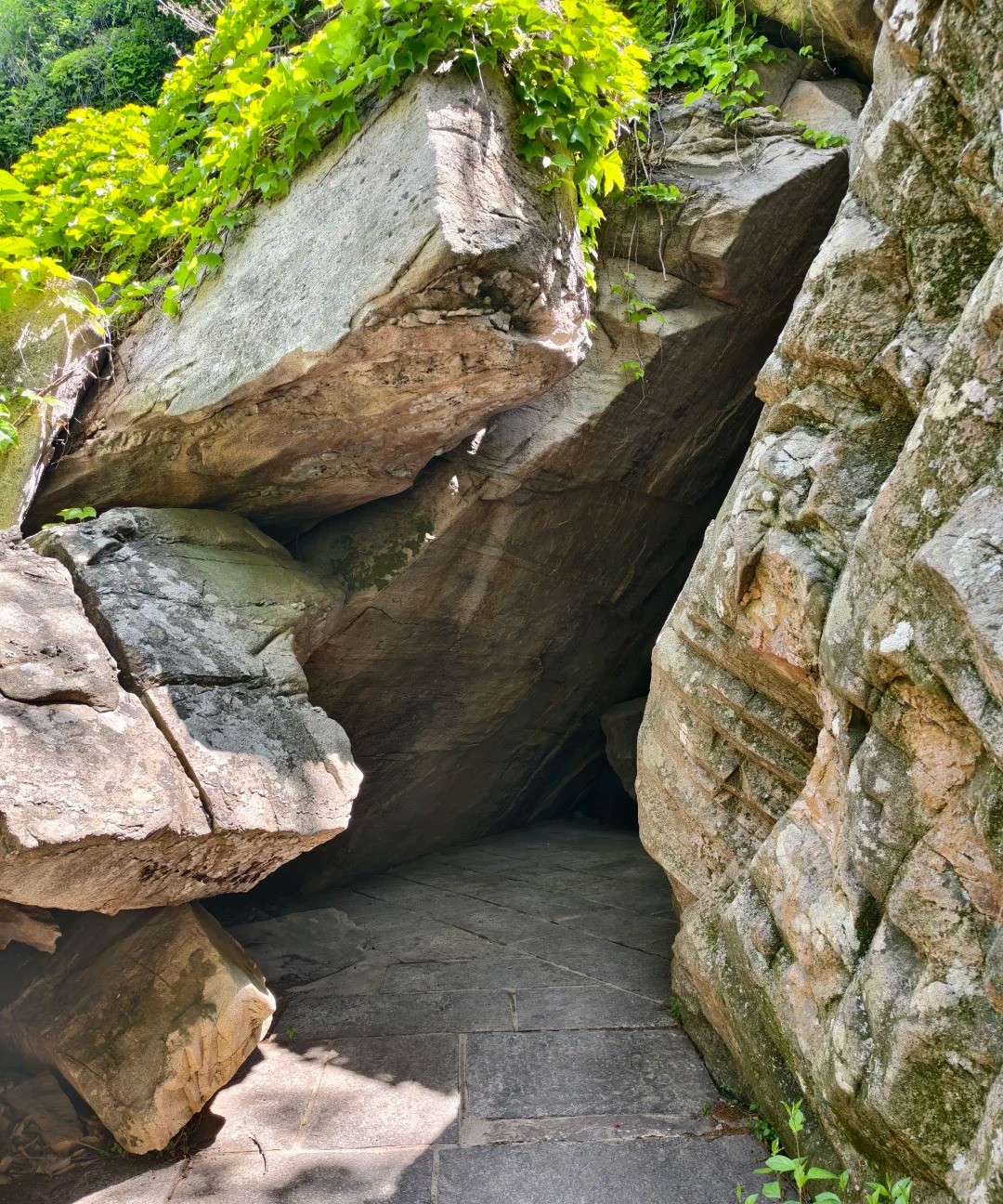
Huaguo Mountain (Mountain of Flowers and Fruit) is without question Lianyungang's leading calling card. In the story of Journey to the West, the Monkey King's home is on this mountain, and Huaguo Mountain is therefore long known as "the Monkey King's hometown"; myth and landscape bring out the best in each other here, making it the first stop for visitors to the port city. Yunü Peak, the main peak of Yuntai Mountain, is 624.4 meters high, the highest peak in Jiangsu Province; among the mountain the rocks are jagged and the caves open into one another, the Water Curtain Cave hidden within a cliff face, its waterfall screening the entrance like a curtain, so that walking within you feel the cool air on your face. In spring and autumn the mountain takes on fresh green, and from the summit of Yunü Peak, where the sea of clouds surges, sea and sky are one color — you can well understand where the novel's imagining of this place as an otherworldly immortal mountain came from. The whole mountain can be covered in half a day to a day, which makes it a fine first stop on an itinerary.
Kongwang Mountain takes its name from the legend that Confucius once climbed it to gaze at the sea, and though the mountain is not high its cultural weight is great. The cliffside carvings on its southern rock face are art treasures of the Eastern Han period, reckoned by scholars to be 300 years earlier than the Mogao Caves of Dunhuang. The carvings follow the mountain's shape, large and small in graceful disorder, the drapery and bearing of the figures each with its own spirit; standing before the cliff and looking closely, you can feel the piety and ingenuity of the craftsmen of that time. Kongwang Mountain Scenic Area is a national 4A-level tourist attraction, strung together with nearby sights such as Peach Blossom Ravine, and suited to a leisurely half-day visit. From the summit you look out and take in the colors of Jinping Mountain and the outline of the city, while the Qindongmen Avenue below reminds visitors that this has been a gateway facing the sea since ancient times.
Beyond mountain and sea, another part of Lianyungang's heritage is carved in stone. Across the city's land are distributed 948 stone carvings of every kind, from rock paintings and cliffside statues to inscriptions and steles, stretching from high antiquity to modern times, complete in variety — it may well be called a "prefecture of stone carvings." The Jiangjun Cliff rock paintings, praised as the "Eastern Book of Heaven," have lines ancient and plain and meanings deep and veiled, and to this day have not been fully deciphered; the Teng Hualuo prehistoric city site, called "the first city of the Chinese East," pushes the footprints of local civilization further and further back. Nine national key cultural relics protection units and six national intangible cultural heritage items, including the Haizhou five great palace tunes, the Huai salt-making technique and the Donghai crystal-carving technique, together watch over the memory of this city. Walking among mountain and sea and coming upon stone carvings unawares is a way of reading that is Lianyungang's alone.
Lianyungang's character is half mountain and sea, half cultural lineage. The world-renowned Journey to the West and Flowers in the Mirror were both born here, and myth and fiction have gilded this landscape with romance; it is said that the Qin alchemist Xu Fu set sail eastward from here, and the legends of Nüwa mending the sky, Jingwei filling the sea, Confucius gazing at the sea and the First Emperor whipping the stones also originated here — the ancestors left all their imaginings of the sea in this place. In the Song dynasty Su Shi passed through Haizhou twice, leaving the lament "Lush Cangwu, mountain above the sea, where Penglai and Fangzhang hover between being and nothing," writing the ethereal air of the sea-girt Yuntai Mountain into verse. Today, as you travel among mountain and sea, these allusions are there to be picked up at will: behind a place name, a stone carving, a pavilion, there is often a story.
03To touch the old found…
To touch the old foundation of Lianyungang, you must go to the ancient city of Haizhou. This is where the city began: in the Qin dynasty Qu County was set up here, and after the Eastern Wei the seat of Haizhou's administration long stood here, with the texture of old times still kept in the lanes. The well-preserved brick-and-stone base of the Bell and Drum Tower has weathered wind and rain, the old well in the Twin Dragon Wells Garden remains, its spring water once the daily source for the old town; the traces of Quyang Gate, the Confucian Temple and the City God Temple interlace, sketching the outline of an ancient town of northern Jiangsu (Subei). Today the old city has welcomed in small creative shops and teahouses; by day you can see the old houses and wells, and at night the lamplight is warm and gentle. Walk a slow circuit, and the two-thousand-year administrative history of Haizhou takes on a concrete, tangible shape.
Having seen the mountains, it is time to see the sea. Lian Island is the largest island in Jiangsu and a national 5A-level tourist attraction, long known as one of "China's ten most beautiful islands." On the island green hills enclose blue sea, the coastline winds around, and reefs and beaches spread out in turn. In summer the seaside bathing beach has fine sand and clear water, a popular spot for visitors from northern Jiangsu (Subei) and southern Shandong to enjoy the waves; walking slowly along the coastal path, on one side belts of trees and mountain tracks, on the other the open Yellow Sea, wind strong and waves white, the view enormously wide. The island still keeps its fishing-village foundation, with seafood going straight from the pier to the table, its freshness undiminished. If you catch a sea fog just rising, mountain and sea half-visible and half-hidden, it adds a further touch of ethereal, immortal air.
Besides Huaguo Mountain and Kongwang Mountain, several other mountain views along the eastern coastal strip are worth putting on the schedule. The Sea-girt Yuntai Mountain, at Sucheng, long praised as a "Peach Blossom Spring," is a national 4A-level tourist attraction; climbing it, you take in the port, the islands and the Yellow Sea at a glance, the view superb. Yuwan is noted for its secluded mountain streams, most pleasant when the water is plentiful in summer; Peach Blossom Ravine adjoins Kongwang Mountain, its spring blossoms and stream water setting each other off, suited to a visit along the way. These scenic areas are all not far from the urban area and can each be covered comfortably in half a day; put together with Huaguo Mountain and Lian Island, they make up just the right itinerary with mountain, sea, antiquity and springs complete.
Lianyungang's sea is not only good to look at but good to eat. The offshore Haizhou Bay is one of China's eight great fishing grounds and also among the first batch of national marine-ranch demonstration zones, with fish, shrimp, crab and shellfish coming to market in turn through all four seasons. Once the fishing moratorium ends, the dockside is at its liveliest — boats come to shore, and the catch, still carrying the smell of seawater, in a blink is in the street-side restaurants. Local people, in eating seafood, put the word "fresh" first, mostly steaming and blanching, so as not to overpower the original flavor; a steaming bowl of seafood noodles, or just-out-of-the-pot small seafood, eaten with the sea breeze and the setting sun, is the most solid everyday fare for the people of the port city. Around Guanyun there is also an odd flavor rarely seen by outsiders, worth a special mention.
04Doudan
Doudan, also called the bean worm, is a high-protein food, its flesh fine and tender and its flavor distinctive; today "Guanyun doudan" has gained recognition as a National Geographical Indication product and is regarded as a delicacy "rare in the country, found only in northern Jiangsu (Subei), unique to Guanyun," a signature dish with which the people of Guanyun welcome guests. First-timers are often daunted at the sight, yet those who have tasted it are often won over by that single mouthful of savor. Besides doudan, the cloud-mist tea grown on the high coastal mountains is one of Jiangsu's four great famous teas, fragrant and mellow, just right in a cup after a climb; specialties such as kudzu powder and local drop vinegar are also often taken home by visitors. The snacks in streets and lanes carry the plain honesty of northern Jiangsu (Subei); simple fare like liangfen and pancakes, with a bowl of hot soup, can leave you perfectly content. In the matter of food, Lianyungang need not stand on ceremony — just follow your nose.
The fate of Lianyungang has always been tangled up with a railway and a port. The Longhai and Lanxin railways, the great artery running east-west across China, end at their eastern tip right here; in 1933 the terminal port of the Longhai Railway was completed, Lianyungang took its name from the port, and step by step it grew into today's international hub seaport. As the eastern starting point of the New Eurasian Land Bridge economic corridor and a strategic node city at the intersection of the Belt and Road, Lianyungang is the most convenient sea outlet for the central and western provinces. In 2021 Lianyungang Port was approved as the starting point of the Land Bridge Corridor and one of the country's 11 international hub seaports, and designated a port-type national logistics hub, with its channel already reaching 300,000 deadweight tonnage. Standing by the sea watching the great ships come and go, you understand the weight of the phrase "linking mountains, linking seas, linking all under heaven."
The meaning of the port is seen most clearly at the China-Kazakhstan (Lianyungang) logistics cooperation base. This is the first physical project of the Belt and Road Initiative to land in China; train after train sets out from here, crossing the continent straight to Central Asia and Europe; grain and mineral products from the Central Asian countries are likewise gathered, distributed and transshipped at Lianyungang along the same corridor, and by way of this sea outlet go out to the Pacific. At present the base's rail freight routes already cover 104 international freight stations, and its transit volume leads the country. Rails and shipping lanes, wharves and yards join seamlessly here, making this city on the shore of the Yellow Sea a veritable meeting point of land and sea. For travelers, you may not walk into the working area, but passing outside the port zone, seeing the bridge cranes like a forest and the freight trains shuttling, you will of yourself feel the vastness of standing within a great corridor.
Lianyungang lies in the transitional zone between the warm temperate and subtropical belts, and under the moderating influence of the sea its climate is humid with four distinct seasons. The annual average temperature is 14.5 degrees Celsius, the average July temperature in the hottest month 26.5 degrees Celsius, and the multi-year average precipitation 883.9 millimeters; no severe cold in winter and no extreme heat in summer make it quite comfortable to the body. Such a climate has also shaped the rhythm of the scenery: in spring the fringe trees on the mountains and the new leaves come out together, in summer the seaside breeze is cool and gentle, the peak season for going into the water; in autumn the air is clear and brisk, best for climbing and looking at the stone carvings; in winter there are hot springs to soak in. For visitors from the south, the summer here is a natural summer retreat; for visitors from the north, the winter seaside is not hard to bear.
05Every year
Every year, April to October is the best tourist season in Lianyungang, when mountain and sea each have their own highlights. In April, go up Huaguo Mountain: grasses and trees are fresh green, and it is just the time to climb high; around June the cherries ripen, and in the orchards of the near suburbs you can pick and taste as you go; July and August are the golden period for the seaside, when the beaches of Lian Island and the streams of Yuwan are at their coolest; in September and October the sky is high and the clouds light, and the stone carvings and mountain colors of Kongwang Mountain and the Sea-girt Yuntai Mountain are at their finest. Even in winter there are the hot springs of Donghai to warm you. If you dislike the sun yet want to see the sea, early summer and early autumn are the best times to come: the seawater is still warm, the visitors gradually fewer, and the itinerary unhurried.
Lianyungang lies in the middle of China's coast, with land, sea and air transport all in place. The Longhai Railway ends here at its eastern tip, freight trains and passenger trains shuttling through; expressways form a network in all directions, so driving north to Qi and Lu or south to the Jianghuai region is convenient; the civil aviation airport connects to the country's major cities, and sea routes join the port to the wider world. The sights within the city are moderately spaced: Huaguo Mountain and Kongwang Mountain adjoin the urban area, while Lian Island and the Sea-girt Yuntai Mountain are along the eastern coastal strip, easy to arrange whether you drive or take a taxi. For travelers planning a loop, making the urban area your base and radiating out for day trips is the most efficient way.
If you have three days, you might go like this. Give the first day to the mountain: in the morning climb Huaguo Mountain, from the gate through the Water Curtain Cave up to Yunü Peak; in the afternoon come down and turn to Kongwang Mountain to see the cliffside carvings; toward evening return to the city and rest. The second day, head for the sea: go to Lian Island, spend the morning on the beach, in the early afternoon follow the coastal path around the island to catch the breeze, then on the way back enter the urban area and pick a local restaurant for a hearty seafood meal. Leave the third day for the old town and the near suburbs: in the morning stroll the ancient city of Haizhou, see the Bell and Drum Tower and the Twin Dragon Wells, and find a teahouse to sit in; in the afternoon, as your mood takes you, go to Yuwan or Peach Blossom Ravine to round out the quiet of mountain and water.
If your time stretches to four days, you may as well slow the pace. On the fourth day you can go to Donghai County, a county town long known as the "world capital of crystal," where the crystal trade and processing are famous far and near, and looking at the rough stone and choosing goods is an eye-opener; then soak in a local hot spring to give the trip a comfortable ending. You can also do the opposite and split the mountain-climbing and sea-viewing into half days each, leaving whole stretches of time to simply daydream by the sea. Families with children will find the museums and the revolutionary memorial hall in the urban area are national 4A-level scenic areas, with solid displays, good for half a day of parent-child time.
06If your timing works o…
If your timing works out, coming during a festival is even more interesting. The city holds events year round such as the "Lianyungang Summer Tourism Festival" and the "Journey to the West Culture Festival"; summer nights by the sea are very lively, with markets and performances often both inside and outside the scenic areas. As for lodging, the central urban area has convenient transport and concentrated dining, good as a base; if you want to see the sea and hear the waves, choose a resort on Lian Island or the eastern coastal strip; if you prefer quiet, you can stay at the foot of Sucheng's mountain, where pushing open the window at dawn shows you the mountain colors. Whichever way you stay, it is wise to avoid the hottest week or two of summer, when the crowds at the seaside are densest and the experience somewhat diminished.
The charm of Lianyungang is that mountain, sea, port and city are all close enough together. Watch the sea of clouds from Yunü Peak at dawn, step on the sand at Lian Island at noon, touch the stone inscriptions in the old city in the afternoon, and sit by the pier over a seafood dinner at dusk — a schedule that in other cities might have to be split into several trips can be completed here within a single day. It is neither noisy nor fashion-chasing, but quietly sets myth, history, mountains and rivers and the warmth of daily life side by side, waiting for the curious to come and look slowly through them. If you are thinking of walking the whole Jiangsu coastline, you may as well put Lianyungang first: having seen mountain and sea meet here, when you go to look at other seas you will have a basis for comparison in your heart.