01Shenyang is the capita…
Shenyang is the capital of Liaoning Province, situated in the middle of the Liao River Plain. It is both a National Historical and Cultural City and an important international central city of Northeast Asia, long praised as "the birthplace of one dynasty and the capital of two emperors," and three UNESCO World Cultural Heritage sites stand within its bounds. It has a 7,200-year history of human culture and a 2,300-year history of urban construction; the city covers 13,000 square kilometers, administers 10 districts, 2 counties and 1 county-level city, hosts 4 national-level development zones, and has a permanent resident population of 9.243 million, among whom live 56 ethnic groups including the Han, Manchu, Mongol, Korean and Xibe. The city has both the grandeur of an early Qing capital and the sinews of a modern industrial city. More than 1,500 historical and cultural relics survive across the city; among them, the Shenyang Imperial Palace is one of the two best-preserved ancient palace complexes in China, while the Zhao Mausoleum and the Fu Mausoleum respectively bury Hong Taiji, Emperor Taizong of Qing, and Nurhaci, Emperor Taizu of Qing. In the city, the Zhang Xueliang's Former Residence Exhibition Hall, Zhongjie Pedestrian Street, the China Industrial Museum and the former site of the CPC Manchuria Provincial Committee each occupy their own corner, gathering the upheavals of modern times and the memory of industry into the streets and lanes. Shenyang lies at the northern edge of the temperate Asian monsoon climate zone, with four distinct seasons; summer and autumn are clear and bracing and the best times to travel. Palaces, mausoleums, old streets and exhibition halls lie mostly within the urban area and are easy to reach, so the city can be visited in spring, summer, autumn or winter alike; the itinerary is compact yet unhurried, and two or three days are usually enough to trace a clear route — a city well worth savoring in detail.
Shenyang is the capital of Liaoning Province, sitting in the middle of the Liao River Plain. It is an international central city of Northeast Asia, a National Historical and Cultural City, and an international comprehensive transport hub. The city covers 13,000 square kilometers, administers 10 districts, 2 counties and 1 county-level city, hosts 4 national-level development zones, and has a permanent resident population of 9.243 million, among whom live 56 ethnic groups including the Han, Manchu, Mongol, Korean and Xibe. People often describe the city with the phrase "the birthplace of one dynasty and the capital of two emperors": this was Shengjing, the capital of the Qing Dynasty before it entered the pass, and also a stage of modern China's industry and of its men of destiny. The city is not large yet dense with stories; palaces, mausoleums, old streets and exhibition halls lie mostly within the urban area and are easy to reach on foot.
Shenyang has a 7,200-year history of human culture and a 2,300-year history of urban construction. The Xinle site pushes the earliest settlement of this land back more than seven thousand years; in the ages that followed, successive dynasties established administrative offices here, and in 1625 Nurhaci, Emperor Taizu of Qing, moved his capital to this place and built palaces, making Shenyang the political center of Northeast China, where palaces and marketplaces henceforth grew up together. After the Qing army entered the pass and made Beijing its capital, the city still administered the military and political affairs of the Northeast under the name Shengjing, and during the Qianlong reign a temporary palace and the Wensu Pavilion were added. Today more than 1,500 historical and cultural relics survive across the city, and the Shenyang Imperial Palace, the Fu Mausoleum and the Zhao Mausoleum are inscribed on the World Heritage List.
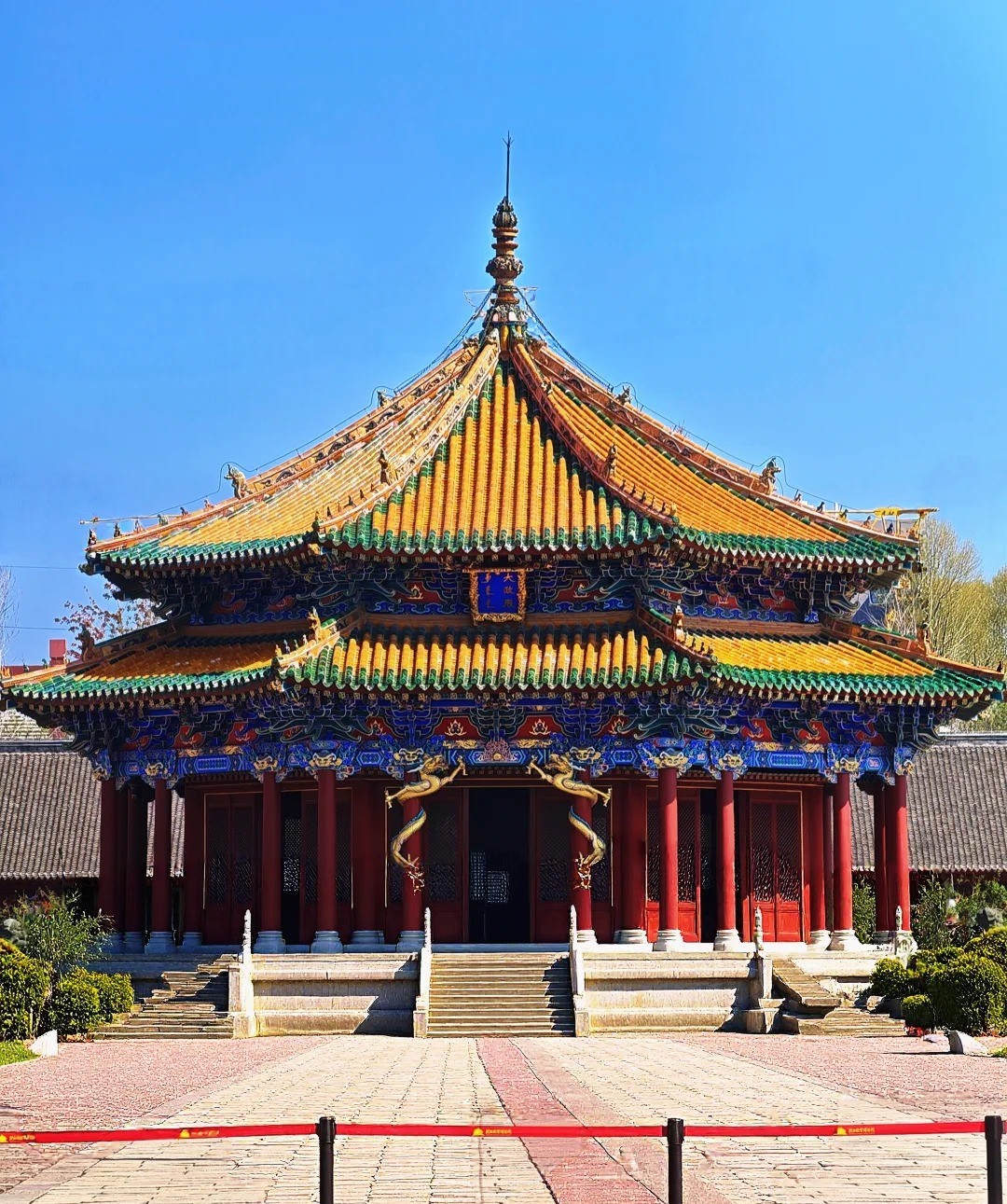
The Shenyang Imperial Palace stands at the center of Shenyang's Ming-Qing square city. One of the two best-preserved ancient palace complexes in China, it was first built in 1625 and covers 60,000 square meters, retaining 114 Qing-era buildings with more than 500 rooms. Its complex is divided by time of construction and by layout into three routes, east, central and west. The eastern route comprises the Dazheng Hall and the Ten King Pavilions, built at the time Nurhaci made Shenyang his capital; the central route is the early-Qing "inner palace," together with the temporary palace and the Shengjing Ancestral Temple added after the capital moved to Beijing; the western route consists of the Wensu Pavilion, the theatre stage and other structures added during the Qianlong reign. The three routes were completed successively over nearly 160 years, and the features of each period remain clearly distinguishable.
02The Shenyang Imperial …
The Shenyang Imperial Palace is also a museum of ancient culture and art built upon a palace foundation. The Shenyang Imperial Palace Museum was established in 1926 and became a National First-Class Museum in 2017; in 1961 the palace was announced by the State Council as one of the first batch of Major Historical and Cultural Sites Protected at the National Level, and in 2004 it was inscribed on the World Heritage List together with the Fu Mausoleum and the Zhao Mausoleum. The architecture itself is the attraction: it embodies the rich traditional culture of the Manchu people, gathers the architectural and decorative elements of the Han, Manchu, Mongol and Tibetan peoples, and blends in the ways of local dwellings; it represents the technical and artistic heights of palace architecture before the Qing moved its capital to Beijing, and is an important physical record for the study of early Manchu court life.
Beiling Park in the north of the city was originally a royal mausoleum and was opened as a park in 1927, covering 3,187,400 square meters. The world-renowned Zhao Mausoleum stands within it; it is the tomb of Hong Taiji, Emperor Taizong of Qing, and Empress Xiaoduanwen, first built in 1643 and basically completed in 1651, after which the Kangxi, Qianlong, Jiaqing and other reigns repeatedly added to and rebuilt it, forming the largest ancient architectural complex among the three Shengjing mausoleums of the Qing. The Zhao Mausoleum covers 160,000 square meters and retains 38 ancient buildings or groups of buildings; it follows the regulations of Ming imperial tombs while incorporating the local features of the period when the Manchu rose, making it a typical example of Manchu-Han cultural fusion in imperial tomb architecture.
The Zhao Mausoleum was listed as a Liaoning Provincial Key Cultural Relic Protection Unit in 1963, a Major Historical and Cultural Site Protected at the National Level in 1982, inscribed on the World Heritage List in 2004, named a National Key Park in 2007, and became a national 4A-level tourist attraction in 2009. Beiling Park is laid out around the mausoleum and divided into three parts, the mausoleum proper, the area before it and the area behind it; behind the mausoleum stretches a forest of ancient pines for miles. The sighing of pines, the red walls and the glazed tiles take on a different mood in each season, and within the park there are also lakes and tree-lined paths: fresh green in spring, cool shade in summer, colored leaves in autumn and snowscapes in winter draw local people here all year round for morning exercise and strolls.
Qing Fu Mausoleum, below Tianzhu Mountain east of the city and commonly called the East Mausoleum, is the tomb of Nurhaci, Emperor Taizu of Qing, and Empress Xiaoci Gao, née Yehenara. It stands on Tianzhu Mountain on the north bank of the Hun River in the eastern suburbs of Shenyang, about 18 kilometers from the urban area; the Fu Mausoleum precinct covers 557.3 hectares, of which the mausoleum proper occupies 16 hectares. The precinct is marked off by boundary posts in green, white and red; in front of the mausoleum, 1,514 wooden palings stand on three sides — these served both as the boundary marker of the mausoleum and as a security enclosure of the time, and together with the red walls and boundary posts they enclosed the whole precinct. In the eighth year of the Shunzhi reign the Fu Mausoleum was basically completed, and it was later enlarged through the Kangxi, Qianlong and other reigns until its scale was fully furnished; ancient pines grow into forests here, and together with the square city and the stele pavilion they create a solemn, quiet atmosphere for those who come to trace the past.
03Passing through the ma…
Passing through the main red gate, four pairs of the stone statues along the spirit way stand among dark pines and green cypresses; at the end of the level ground, 108 brick steps are built following the lie of the hill. Climbing them, one is met by the Divine Merit and Saintly Virtue Stele Pavilion, whose stele was added in the twenty-seventh year of the Kangxi reign and whose inscription recounts Nurhaci's merits. The whole mausoleum complex is built on the foothills and slopes according to the terrain, forming a shape low in front and high behind, long and narrow from north to south; at the center of the square city is the Long'en Hall, flanked by the eastern and western side halls, and behind the hall stands the Daming Tower, the "eternal auspicious ground" of Nurhaci and his consorts. Looking out from the city wall, ancient trees reach the sky, halls and pavilions stand in ranks, and golden tiles and red walls set off the mountain, the whole scene exceptionally open — a key part of Shenyang's Qing-culture tourism.
The Former Residence of Zhang Xueliang, in Shaoshuai Fu Lane off Chaoyang Street in Shenhe District, was the official residence and private home of Zhang Zuolin and his son Zhang Xueliang, commonly known as the Marshal's Residence; today it is open to the public as the Zhang Xueliang's Former Residence Exhibition Hall. The residence was first built in 1914 and covers a total area of 53,000 square meters, with a floor area of 35,000 square meters; it is a large, well-preserved former residence of a notable figure in Northeast China. The exhibition hall was established in 1988, its site being this group of Major Historical and Cultural Sites Protected at the National Level. After a hundred years the courtyard layout has largely kept its original form; visitors here can see both the architecture and a stretch of the turbulent history of the Republic of China era — the most direct surviving scene of Shenyang's modern history, and a stop many are reluctant to leave after coming to Shenyang.
The group of buildings comprises a three-courtyard siheyuan, the Great Blue Building, the Small Blue Building, the Guandi Temple, the Red Building complex, the former residence of Zhao Yidi, the former site of the office and the former site of the Bianye Bank, among other heritage structures; the old arrangement in which the Zhangs worked, lived and received guests unfolds courtyard by courtyard. The Zhang Xueliang's Former Residence Exhibition Hall is a National Second-Class Museum and a national 4A-level tourist attraction. The lane before the Marshal's Residence is not wide, yet it is the most concentrated stretch of Shenyang's modern history. Leaving the residence and walking a short way along Chaoyang Street brings one to Shenyang Road and the Zhongjie area, where the former residence, time-honored shops and commercial blocks can be strung into a half-day route best enjoyed on foot, looking as you go.
Zhongjie Pedestrian Street is the first pedestrian street in China, with a history of more than 390 years. It lies within Shenyang's square city, runs 1,400 meters in length and 28-30 meters in width, covers a total area of 1.05 million square meters, and has a total commercial floor area of 1.83 million square meters, with more than 3,500 shops currently within the street. As one of the pilot pedestrian streets for national renovation and upgrading, Zhongjie blends shopping, dining and the old city's cultural thread; the alleys and time-honored shops at the foot of the imperial city spread out along the lanes, making it a fine place to stroll and seek out flavors. After night falls and the lights come on, voices and shop signs grow lively together, and here one feels Shenyang's street life most keenly.
04Shenyang's cultural la…
Shenyang's cultural landmarks are not limited to palaces, mausoleums and the Marshal's Residence. Within the city, the China Industrial Museum, the former site of the CPC Manchuria Provincial Committee, the Xinle Site Museum and the Xibe Ancestral Temple each occupy their own corner, together stringing up the city's modern upheavals and industrial memory. The China Industrial Museum carries the city's industrial pride and tells clearly the story of how Shenyang came to be an important national industrial base; the former site of the CPC Manchuria Provincial Committee records another kind of revolutionary memory in red. Modern relics and industrial heritage echo one another in the same blocks, so that within half a day one can discern the city's sturdy, weighty undertone, and a single circuit leaves one with a deeper sense of it.
As a center of modern services in Northeast China and a regional highland of scientific and technological innovation, Shenyang keeps switching between old and new: on one side the palace walls and gray tiles of the square city, on the other the modern buildings and industrial parks along the Hun River. The contrast is not jarring; instead it adds a layer to travel — see history in a palace courtyard in the morning, industry in a museum in the afternoon, and return to the old streets at dusk for a warm dinner, and in a single day you walk through both a century and a millennium. If time is ample, you can also watch a sunset by the Hun River and feel the relaxed side of this city.
Shenyang's food carries the forthrightness of the Northeast, generous in portion and bold in flavor. In the small eateries along the streets and in the alleys, homely cooking such as stews, smoked and braised dishes, barbecue and hotpot shows the most skill; a charcoal stove and a mouthful of hot soup are the daily fare of many Shenyang people. The city kneads together the eating habits of many ethnic groups, its flavors tending salty, fresh and mellow; staples and stews often come to the table together, with an emphasis on warmth and substance. When you are tired from walking, sit down in any small shop and you will most likely not be disappointed; on summer nights the smoke and aroma of open-air barbecue are especially thick, and with a glass of iced drink it best eases the fatigue of a day and best reveals the easy hospitality of Shenyang people.
Shenyang lies at the northern edge of the temperate Asian monsoon climate zone, with four distinct seasons, concentrated rainfall and abundant sunshine. The annual average temperature is 8 degrees Celsius; July is the hottest, with an average of 24.6 degrees Celsius, and January the coldest; the frost-free period is 185 days, the average annual precipitation is 598.9 millimeters, and annual sunshine totals 2,541 hours. Spring brings frequent strong southwesterly winds and high evaporation, with spring droughts possible; summer is hot and rainy; autumn has little wind and many clear days; winter is cold and dry with little rain or snow. Summer and autumn are clear and bracing and the best times to travel, while in winter one can see the red walls and golden tiles in snow, which makes the outlines of the palaces and mausoleums all the more distinct; each season has its own way to be enjoyed.
05Shenyang is an interna…
Shenyang is an international comprehensive transport hub, its railways, highways and aviation woven into a network, making travel to and from all parts of Northeast China and the lands within the pass convenient. Within the city, the subway and buses cover the main attractions; the Imperial Palace, the Marshal's Residence and Zhongjie are not far from one another and can be linked on foot or by a few stops of transport; Beiling and the East Mausoleum are also reachable by public transport, so there is no need to worry about transfers. For short-trip travelers, staying in the square city or around Taiyuan Street makes getting around and finding food easy; leaving early and returning late are both convenient, and over a few days little time is spent on the road.
To visit Shenyang, two or three days are enough for a general view. On the first day you can link the Shenyang Imperial Palace and Zhongjie: palaces in the morning, a stroll and snacks in the afternoon, and a finish at the Marshal's Residence at dusk; on the second day go to Beiling Park in the north of the city to see the Zhao Mausoleum, then south to the China Industrial Museum; on the third day, if there is time to spare, head east to Tianzhu Mountain to see the Fu Mausoleum, or walk along the bank of the Hun River, to see another side of the city in full. Following such a route, palaces, the two mausoleums and modern relics will mostly not be missed, and the pace is not rushed; if your stamina is limited, you may also pick and choose among the sights according to your interests, without insisting on seeing everything.
If you have only one day, you can also concentrate on the square city: the Shenyang Imperial Palace in the morning, Zhongjie in the afternoon, and the Zhang Xueliang's Former Residence at dusk — the three are not far apart and can be covered on foot plus a short bus ride. If you bring children, you can add science and nature exhibition halls, combining learning with fun; if you are traveling with companions, you might leave the night to the barbecue stalls and the lamplight of the old streets, to feel a Shenyang quite different from the daytime. Those who love museums can give a whole day to the China Industrial Museum; those who prefer nature will do well to walk a circuit around the lake in Beiling Park. However different people are, each can find their own way to travel; the key is to be clear first about what you most want to see on this trip.
There is no need to pack the itinerary too full. Half of Shenyang's attractions lie in the famed palaces and mausoleums, the other half hidden in ordinary streets and lanes: the old alleys in the square city, the old shops on Taiyuan Street, a greeting in the market — all are the everyday undertone of this city. Leave yourself a little time to wander, take a ride on a tram, or simply sit idling on a park bench; you will remember Shenyang more easily, and more easily meet surprises beyond your plans. Travel need not be a rush through everything; slow the pace a little, and when tired find a small shop to sit in; what lingers in the memory more than checking off a few sights is often just these unexpected moments.
06In spring see the flow…
In spring see the flowers, in summer escape the heat, in autumn enjoy the leaves, in winter tread the snow — each season has its own sights in Shenyang. If you favor Qing history, see the Imperial Palace and both mausoleums in full; if you favor the upheavals of modern times, the Marshal's Residence and the two museums can fill a whole day; if you only want to wander at will, the square city and both banks of the Hun River are pleasant places to go. Whichever route you choose, it is advisable to wear comfortable shoes, because the best scenery here often emerges slowly after you have walked a few streets, and it cannot be hurried. Shenyang's public transport is convenient and transfers between sights are not difficult; even if you are unfamiliar with the routes, following a navigation app will get you there smoothly. If you drive, note that parking is inconvenient on some roads in the urban area, and it is often less trouble to park on the edge of a scenic area and walk in.
Shenyang's goodness lies in the coexistence of the weighty and the everyday: on one side the millennia of history in palaces, mausoleums and museums, on the other the warmth of life in alleys, markets and small roadside eateries. It does not hurry to show visitors anything; it only asks you to slow your steps, walk a while on the old streets of the square city and sit a while in the sighing pines of the mausoleums, and you will grasp the weight of this "city of two emperors." Bring comfortable shoes and set aside time to wander; Shenyang will give you an unhurried answer and will let your steps slow down of themselves.
If one reminder must be given to first-time visitors, it is this: do not fix your eyes on the palaces alone. Shenyang's Qing culture is certainly the protagonist, but the modern upheavals in Zhang Xueliang's Former Residence and the roar of machines in the China Industrial Museum are equally worth half a day. Put Qing history and modern history on one line and view them against each other, and you will find this city's character remarkably complete: it keeps to the old rules yet dares to open the new, weightiness and forthrightness side by side. It is not demonstrative, yet it is worth looking at; it does not hurry to please anyone, yet it can always stir the heart at some corner — this is probably what moves people most about Shenyang.