III. Architectural Layout and Detailed Scenic Areas
The architectural layout of Mount Putuo follows the contours of the mountains and is distributed along the coast, creating a unique landscape of 'temples embracing mountains, and mountains embracing the sea'. The core architectural complex is concentrated around the three major temples and the Nanhai Guanyin area.
1. Puji Temple (Front Temple)
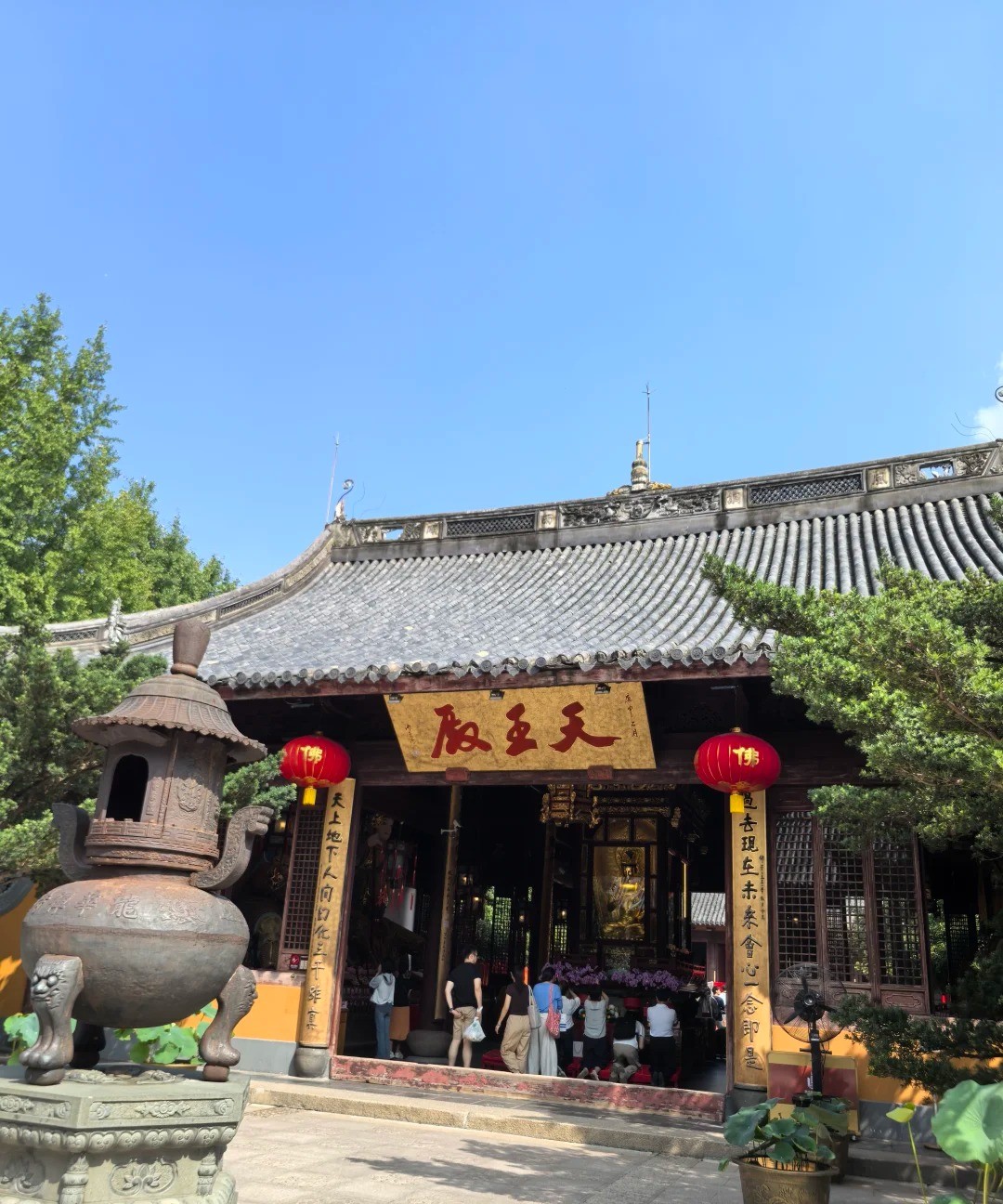
Puji Temple, located at the foot of Lingjiu Peak, is the main temple of Mount Putuo and the largest on the island. It was first built in the third year of Yuanfeng in the Northern Song Dynasty (1080 AD), originally named 'Baotuo Guanyin Temple'. During the Kangxi reign of the Qing Dynasty, it was granted the plaque 'Puji Qunling', and thus adopted its current name.
- Architectural Scale: Covers an area of approximately 26,000 square meters. Along the central axis are the Imperial Stele Hall, Heavenly Kings Hall, Great Round Hall, and Sutra Depository.
- Great Round Hall: Seven bays wide and five bays deep, about 18 meters high, it is the main hall of Puji Temple. Inside, a statue of Pīlú Guanyin, 8.8 meters tall, is enshrined, surrounded by 32 manifestation statues of Guanyin, symbolizing Guanyin's 32 manifestations.
- Haiyin Pond: In front of the temple lies a release pond covering about 15 mu (1 hectare), named 'Haiyin Pond'. Three stone bridges span the pond, with the central one being the 'Imperial Bridge', reserved for emperors. When lotus flowers bloom in the pond, they create a picturesque scene with the ancient temple.
- Special Feature: The bell tower of Puji Temple houses a 10,000-jin bronze bell, whose deep toll is known as the 'Putuo Morning Bell'.
2. Fayu Temple (Back Temple)
Fayu Temple, located to the left of Baihua Summit and below Guangxi Peak, was first built in the eighth year of Wanli in the Ming Dynasty (1580 AD), originally named 'Haichao Nunnery'. In the thirty-eighth year of Kangxi in the Qing Dynasty (1699 AD), it was granted the plaque 'Tianhua Fayu', and thus adopted its current name. Fayu Temple is famous for its 'Nine Dragon Hall', whose architectural style blends Ming and Qing imperial palace and Jiangnan garden features.
- Architectural Scale: Covers an area of approximately 33,000 square meters, rising layer by layer along the mountain slope, with six halls in total.
- Nine Dragon Hall (Great Round Hall): Seven bays wide and five bays deep, about 22 meters high. The ceiling features a 'Nine Dragon Caisson' (a decorative ceiling recess), formed by nine carved wooden golden dragons coiling around, with the central one holding a pearl in its mouth. This is a rare masterpiece of Ming Dynasty wood carving. Inside, a statue of Guanyin is enshrined, surrounded by eighteen arhat statues.
- Jade Buddha Hall: Houses a jade Buddha statue about 1.5 meters tall, brought from Myanmar, carved from pure white jade with exquisite craftsmanship.
- Special Feature: The 'Nine Dragon Caisson' in Fayu Temple is the pinnacle of architectural art on Mount Putuo, with its complex structure and ornate paintings representing the highest level of Ming Dynasty wood construction.
3. Huiji Temple (Foding Mountain Temple)
Huiji Temple, located on the highest peak of Mount Putuo, Foding Mountain (291.3 meters above sea level), was first built during the Wanli reign of the Ming Dynasty and expanded in the fifty-eighth year of Qianlong in the Qing Dynasty (1793 AD). Due to its mountaintop location, it is often shrouded in clouds and mist, creating the scenic 'Buddha's Summit Cloud Waves'.
- Architectural Scale: Covers an area of approximately 13,000 square meters, with a compact layout built along the mountain. The central axis includes the Heavenly Kings Hall, Mahavira Hall, and Great Compassion Hall.
- Great Compassion Hall: Houses a thousand-armed, thousand-eyed Guanyin statue, about 6 meters tall, cast entirely in bronze with superb craftsmanship.
- 'Buddha Summit, Buddha Above' Stone Inscription: In front of the temple, there is a large rock inscribed with the characters '佛顶顶佛', meaning 'Buddha above the Buddha's summit', symbolizing the supreme status of Buddha.
- Special Feature: Huiji Temple is the only temple on Mount Putuo located at the summit. From here, one can overlook the entire island and the East China Sea, offering an excellent view. The temple is surrounded by Putuo hornbeam trees, a rare species endemic to Mount Putuo, known as the 'Only Son of the Earth'.
4. Nanhai Guanyin Statue
The Nanhai Guanyin Statue, located at Longwan Gang on the southern tip of Mount Putuo, is a landmark of the island. Completed in 1997, the statue stands 33 meters tall in total, with a 13-meter-high pedestal and a 20-meter-high bronze statue weighing over 70 tons. The statue faces the South China Sea, with the left hand holding a dharma wheel and the right hand in the abhaya mudra (fearless gesture), exuding solemnity and compassion. Inside the pedestal is the 'Nanhai Guanyin Merit Hall', which houses various Guanyin statues. This is a must-visit for pilgrims and an excellent spot to watch the sunrise over the sea.
5. Purple Bamboo Grove and Bukenqu Guanyin Temple
The Purple Bamboo Grove is located in the southeastern part of Mount Putuo, named for the purple-red rocks and the abundance of purple bamboo. The Bukenqu Guanyin Temple is located here and is the birthplace of the Guanyin sacred site on Mount Putuo. The existing structure was rebuilt in 1980 and is modest in scale but of great significance. Inside, a Tang Dynasty-style Guanyin statue is enshrined. In front of the temple is Chaoyin Cave, where one can hear the sound of waves crashing against the rocks.